Showing posts with label Finance. Show all posts

Payroll Accounting by Bernard Bieg and Judith Toland


Bernard Bieg and Judith Toland, Payroll Accounting (Cengage Learning; Independence, KY; 2014) 496 pages.

This is a college textbook for students of payroll accounting. It covers all of the topics related to the subject of payroll accounting, as it applies in the United States. The topics covered include:

  • Social Security taxes
  • Medicare taxes
  • Federal and State unemployment taxes, and
  • Federal individual income tax withholding.


Also included with this book is a CD-ROM with payroll templates, and the relevant templates students can use to complete a payroll project. Some editions of this book come with an electronic key for on-line assignments and graded quizzes. Be careful if you buy this book to ensure that the electron key is included, and if your particular course requires it. In short, this is a good example of a comprehensive textbook on United States payroll accounting..

A virtue of this book is that all chapters are of a similar length with each devoted to a specific topic. All topics are covered in sufficient detail for a college level payroll accounting class. He explanations of concepts are clear. Each chapter has a useful review section. The on-line grading and assessment consisted of weekly quizzes, plus med-term and end of term exams. The quizzes were straight forward application of material covered in the text. Quiz and exam format comprised true/false questions and multiple choice questions. Some of these questions used imprecise language that are likely to confuse students who struggle with English grammar, or have a first language other than English. The exams can be a source of frustration confuse due to their reliance on grammar, double-negatives and deliberately imprecise language.

Overall, this is an adequate entry-level payroll accounting textbook, even if it is somewhat expensive. But what textbook isn't expensive these days?


New Ideas From Dead CEOs by Todd Buchholz


New Ideas From Dead CEOs: lasting Lessons from the Corner Office by Todd Buchholz, (New York: MJF Books; 2007), 300 pages.

We all believe that the present time is the peak time for knowledge and wisdom. This book explicitly challenges that proposition or belief by suggesting that iconic business leaders and business founders from the past can provide valuable life and business lessons to people today. In this short book, Buchholz examines the lives and and business challenges of a dozen business leaders. The people he examines are self-made successes that faced numerous ups and owns on their way to making business history. The book is divided into chapters that, for the most part, chronicle one business leader and the business they built. For example, he reviews the life of A.P. Giannini and how he built the Bank of America, Sam Walton and Walmart, Ray Croc at McDonalds, Walt Disney at Disney, Akio Morita at Sony, and Estee Lauder at the company that bears her name. Two chapters cover two people: one covers Thomas Watson Sr. and Jr. at IBM, and another covers Mary Kay Ash and Estee Lauder before he writes a separate chapter on both women. Each chapter provides biographic material including their upbringing, their early careers, decisions they made., and events that forged their distinct goals and aspirations, as well as challenges they faced during the establishment of their business and how they overcame obstacles.

The strength of this book is the wide range of lessons it covers. For example, the story of Walt Disney's loss of ownership of his creative content in the 1920s as an animator formed his resolve to retain ownership of Mickey Mouse, the character the built the Disney corporation. By contrast, the author also shows the importance of concentrating on low prices to the development of Walmart, the use of research and development in the growth of Sony, and the willingness for franchisees to experiment in the development of McDonalds.

This short book is a good introduction in to the lives of successful business founders, and their unique and varied experiences that led to their growth and ability to dominate their various industries.  The book contains a useful end notes section for readers interested in getting more detailed works of the people covered in this book, for example, biographies, autobiographies and studies. It is a book suitable for the curious reader and business owner alike, or student interested in the factors that led to some major businesses becoming what they are today.

Adventure Capitalist: The Ultimate Investor's Road Trip, by Jim Rogers


Jim Rogers, "Adventure Capitalist: The Ultimate Investor's Road Trip," (Random House: New York; 2003), 357 pages.


Jim Rogers, former hedge fund manager, likes to travel. His first book, Investment Biker, recalled his around-the-world trip by motorbike. This book, Adventure Capitalist, is a sequel. It’s an account of his travel around the world by car, a trip that took 3 years. He and his wife made a trip in a customized four wheel drive Mercedes sports car. The journey started in Iceland and continued through the U.K., Southern Europe, Central Asia to China, Japan, Russia, Scandinavia, the east and west coast of Africa, Australia, New Zealand, South America, Central America, and through the USA to Canada and Alaska.


Like Investment Biker, this book is more than a travel book. It contains description of the author’s travels, as we would expect. More interestingly, it contains Roger's opinions on many of the countries he visited, such as whether it was blighted by corruption or poor governance. He is particularly expansive on various countries' financial condition, whether the country’s currency was being debased, and if conditions were optimal for improving the lives of that country’s citizens. As much as he comments on the counties he visits, Rogers also devotes considerable space to reflect on life in the United States and its place in the world. Rogers is an optimistic libertarian, and his travels force him to reflect on US policies, such as foreign policy, foreign aid, various international institutions (such at the World Bank and the International Monetary Fund), and domestic economic policies. These reflections are frequently critical, but are neither theoretical nor polemical, but based on his understanding of the world and various nations gained from his unique perspective as an extensive global traveler.

Roger's investment philosophy is unorthodox, as is his commentary on socio-political situations. His views are rooted in his on the ground observations gained by going into the field where there are few, if any, 5 star hotels. His experience at school, college and business taught him that experts were usually wrong, hence his bias towards learning for himself through his own experiences. His travels are characterized by the slaughter of sacred cows (meaning conventional views), the puncturing of various balloons and the laying to rest the ore-conceptions of the world held by certain "authorities," many of whom have never left home (p.4).

A strength of this book is the recollection of his journeys through a large number of countries he visited; however, this also restricts the author from writing about every country in detail. Some countries are covered in great detail (China) while others are barely mentioned. This limitation sometimes comes across as the story being rushed.  At times, the great distances being covered through exotic locations barely rate a mention.

The book excels in other areas. First, it exposes a few myths about the international travel in Africa and South America, and demonstrates that with ingenuity and determination that it is possible to drive a car around the world. Second, he exposes a few myths and pre-conceived notions about African countries and their government’s economic policies, the causes of poverty and misery, and the causes of prosperity and economic growth – here’s a hint, it not United Nations aid projects. Rogers observes in such a way and with a view to seeing conditions that will encourage profitable investing. Third, Rogers reflects on the USA. His unique perspective of travelling around the world gives him perspective to comment on conditions in the USA, and to reflect and make prediction about the USA’s future. Anyone with more than a passing interest in travel, the USA’s place in the work, and

This book is more than a travel book. It’s a reflection on life, the world, and the place of the USA in the world, and assessing foreign countries as places to invest should enjoy this book.

Rigged: The Story of an Ivy League Kid Who Changed the World of Oil, from Wall Street to Dubai, by Ben Mezrich


Ben Mezrich, "Rigged: The Story of an Ivy League  Kid Who Changed the World of Oil, from Wall Street to Dubai," (Harper Collins: New York; 2007), 294 pages.

Rigged is Mezrich's latest book about kids with Ivy League university educations that go on to make fortunes. In this relatively unexciting and unexceptional story, a Harvard University graduate goes to work for the New York Mercantile Exchange to establish the Dubai Mercantile Exchange.

The most revealing aspect of this book is its expose of the itty-gritty details on how the Dubai Mercantile Exchange was founded, as well as the broader subject of establishing a new business in the Arab world. Readers will discover the importance of working with an Arab partner familiar with the business practices in the West and the Arab world. Readers will also see how such partners can help negotiate difficulties with obtaining approval of religious leaders in circumstances where business practices have some conflict, or potential conflict, with Islamic law. Finally, we see how it is sometimes necessary to appeal to the lower instincts of established industry stalwarts in order to develop new operations.

If this book has any shortcomings, it would be Mezrich's tendency to stray into hagiography and hyperbole. He praises almost without criticism and glorifies the protagonist's success without much broad perspective. Michael Lewis fails spectacularly in writing books that discourage bright young kids from going to Wall Street to get rich. Mezrich has no such moral imperative: he writes books like Rigged that are sufficiently entertaining to encourage bright kids to go to Ivy League school so they can "change the world," which means, find new ways, or new twists on old ways, to make a fortune working on Wall Street.

"Investment Biker: Around the World with Jim Rogers," by Jim Rogers


Investment Biker: Around the World with Jim Rogers, (Hollbrook, MA: Adams Media Corporation; 1994), 402 pages.

From March 1990 through August 1992, the author and his girlfriend travelled around the world on their BMW motorcycles. Starting in New York City, they flew to Ireland and travelled through southern Europe to China and Japan, then turned around and went through northern Europe back to Ireland. They then drove the length of Africa from north to south, almost circumnavigated Australia, rode through New Zealand,  rode through the Americas from Cape Horn in the south to New York in the north east through to Anchorage, Alaska, traveling a total of 65,000 miles. The book is a record of his travels including observations of the countries he visited. Most but not all of the book is devoted to his travels. We learn of the difficulties of riding a bike around the world though conditions ranging from first class roads to bumpy dirt tracks. The book also casts a keen observer's eye at the countries through which he travels. He comments on the living conditions of every country he visits, and gets to the heart of what makes each country successful or unsuccessful. As a professional investor, Rogers also comments on the economic conditions of many countries, primarily based on his observations and interactions with the people he meets. He gets to the heart of what makes a county successful, what makes life good for its citizens, what makes currencies more valuable, and others less valuable. In light of his observations about the countries he visits, he returns to a repeating theme, namely the similarity between the direction of the U.S.A.'s economy and that of failed third-world countries around the globe.

This is a gem of a book. It is s both a record of an amazing round-the-world motorcycle trip, and a reflection on what makes a country successful. Rogers's analysis and writing is direct and honest. It is  unencumbered with flowery introspection or self-doubt. It is full of practical advice and commonsense for the traveller and to a lesser extent the international investor.  If the book has a weakness its his failure to give any detailed observations of his travels through the United States. He also writes comparatively little of his travels through Australia. This limited treatment of two large countries surprised me. I think the book is the poorer than it could have been due to so little coverage of these large countries. Nonetheless, this is a very good book that should be enjoyed by readers interested in travel, investing, and motorcycle travel journeys.

"Confessions of a Tax Collector," by Richard Yancey


"Confessions of a Tax Collector: One Man's Tour of Duty Inside the IRS," by Richard Yancey, (New York:Harper Collins; 2004) 364 pages. ISBN 0-06-055560-2.


No one grows up thinking they want a career as a tax collector. The people that end up doing that job get there somehow. This is one man's story of how he came to be a revenue officer for the Internal Revenue Service ("IRS"). In Confessions of a Tax Collector, former drama teacher Richard Yancey answers an recruitment advertisment in a Florida newspaper (remember those) seeking people to work in The Treasury Department. Attracted by the job security and salary, he applies and is recruited. The book traces his career from his employment interview, training, and his early career. Yancey pulls back the curtain on what the IRS was like in the 1990s, to show us how revenue officer collected income tax revenue for the IRS. 

Exposes  by insiders spilling the beans on what its really like working for an organization usually make interesting reading. This book is no exception. If you are interested in working for the IRS, then Yancey's book should be recommended reading, even though the IRS has changed considerably from the way it is depicted in this book. This book's utility is not confined to future agents wanting know what its really like to work for the IRS. Anyone thinking of working in a job that requires managing a caseload (e.g. investigator, insurance examiner/adjuster, etc) would benefit from it: this book reveals the type of work constraints and limitations associated with such work. Yancey also provides engaging and detailed critiques of how he successfully did his job and closed cases. These are first-rate accounts of what is required in jobs that require you to handle a case load. The book also gives an important lesson for all people: Yancey decided that if he was going to do the job of revenue officer, he was going to be the best revenue agent. Success for him was a decision, and was something he worked hard for and achieved. This is a lesson for all people in that no matter how little you enjoy you job, or are embarrassed by it, namely, there is a lot to be said for deciding to be the best at it and doing it exceptionally well. Who knows where it will lead. In Richard Yancey's instance, its led to a careers as a writer.

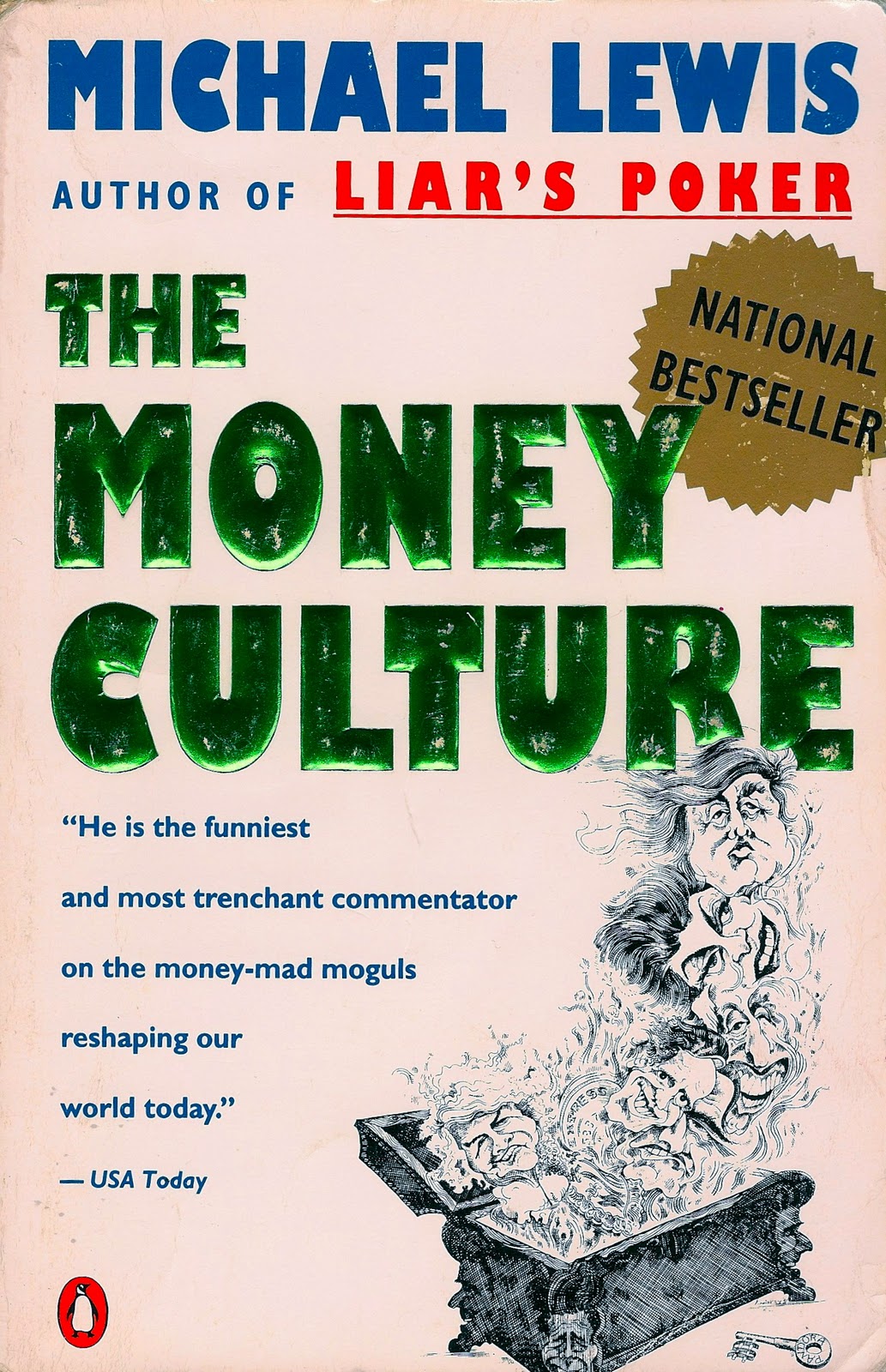
“The Money Culture,” by Michael Lewis


The Money Culture,” by Michael Lewis, (New York: Penguin Books; 1991), 282 pages.

The Money Culture is a compilation of essays and stories written in the later 1980s and early 1990s for various publications, such as Manhattan Inc., New Republic, The New York Times, The Wall Street JournalEurope, and The Washington Post. The book was published in 1991, and appears to attempt to capitalize on Lewis's success with his very successful first book Liar's Poker, a tell all account of his brief career as a Wall Street bond salesman. 

The Money Culture is arranged into three parts. The first part, "New World," examines the new world of modern finance from a variety perspectives, namely, a critique of the absurdity of mass marketing the American Express card as a symbol of exclusivity, to a series of commentaries on the then largest ever leveraged buy-out (the purchase of RJR Nabisco by leveraged buy out firm Kohlberg Kravis Roberts). Lewis gives a glimpse into the democratization of retail investing through his participation in an expensive cruise to the Amazon where customers will be given investment tips and ideas from a host of a television program about investing. We learn how the major new beneficiaries of the new money culture funded by debt are investment bankers educated at the "best school" (meaning Harvard, Wharton, Stanford etc). We also get a glimpse into the future when Lewis states that the late 1980's corporate expansions and corporate takeovers were predominantly funded by debt fund sourced from outside America. So great was the growth in debt that Lewis quoted a Princeton economics professor who made a strong case that the leveraging of corporate America would end in tears. That professor was quoted as stating that the last time we had debt in this range was in the 1920's. The professor is Benjamin Bernanke, the same man that is presently the Chairman of the New York Federal Reserve.

The second part, "Old World," contains essays on the spread of the new model of American-style, debt-fueled business activity to the old world of the United Kingdom and Europe. These stories demonstrate the manifestation of the new, brash, avarice in places where a go-getter graduate from Oxford or Cambridge with fire in the belly and a bit of hard work and a bit of leverage make a fortune as an investment banker, just like his Harvard and Stanford contemporaries.

Part three, "Other World," is a selection of essays about Japan's influence on global finance, how its savings underwrite the West's debt binge, and how it all could come undone in the West if there is another massive Tokyo earthquake and global savings are repatriated to Japan.

The Money Culture is one of two books that mark the beginning of Lewis's career as a writer. The 2010 book The Big Short is his examination of the collapse of the credit bubble. Lewis saw both the end of the credit bubble, and the beginning, so these two books complement each other quite nicely. Although its been over 20 years since these essays were written, The Money Culture marks a useful historical resource on how things were when the credit boom started, how outrageous the behavior and actions were at the beginning and at the end, and how by comparison after two decades these events in comparison ht deals seem so small, and the numbers miniscule and activities somewhat quaint. We are now used to financial scandal and endemic bad behavior that it flows over us like water off a duck's back. We are the poorer for it. The Money Culture is also a timely reminder to us as a mile marker on the road to the insolvency of the West and the financial armageddon potentially facing the United States: The Money Culture shows us that things weren't as bad as they are now, and with a bit of clear thinking and foresight, all (or a lot of) the present problems facing the world could have been avoided or ameliorated.

The Money Culture has passed the test of time. it is well written and covers topics relevant today. Some of the people featured are known to us today, and others are now forgotten, captured here at their moment of their greatest impact when their impact was at its peak. This also serves as a kind of colorful financial history of the mid to late 1980s, a passing parade of colorful characters the like of which we will not see again, not right away, but for perhaps fifteen to twenty years or do.