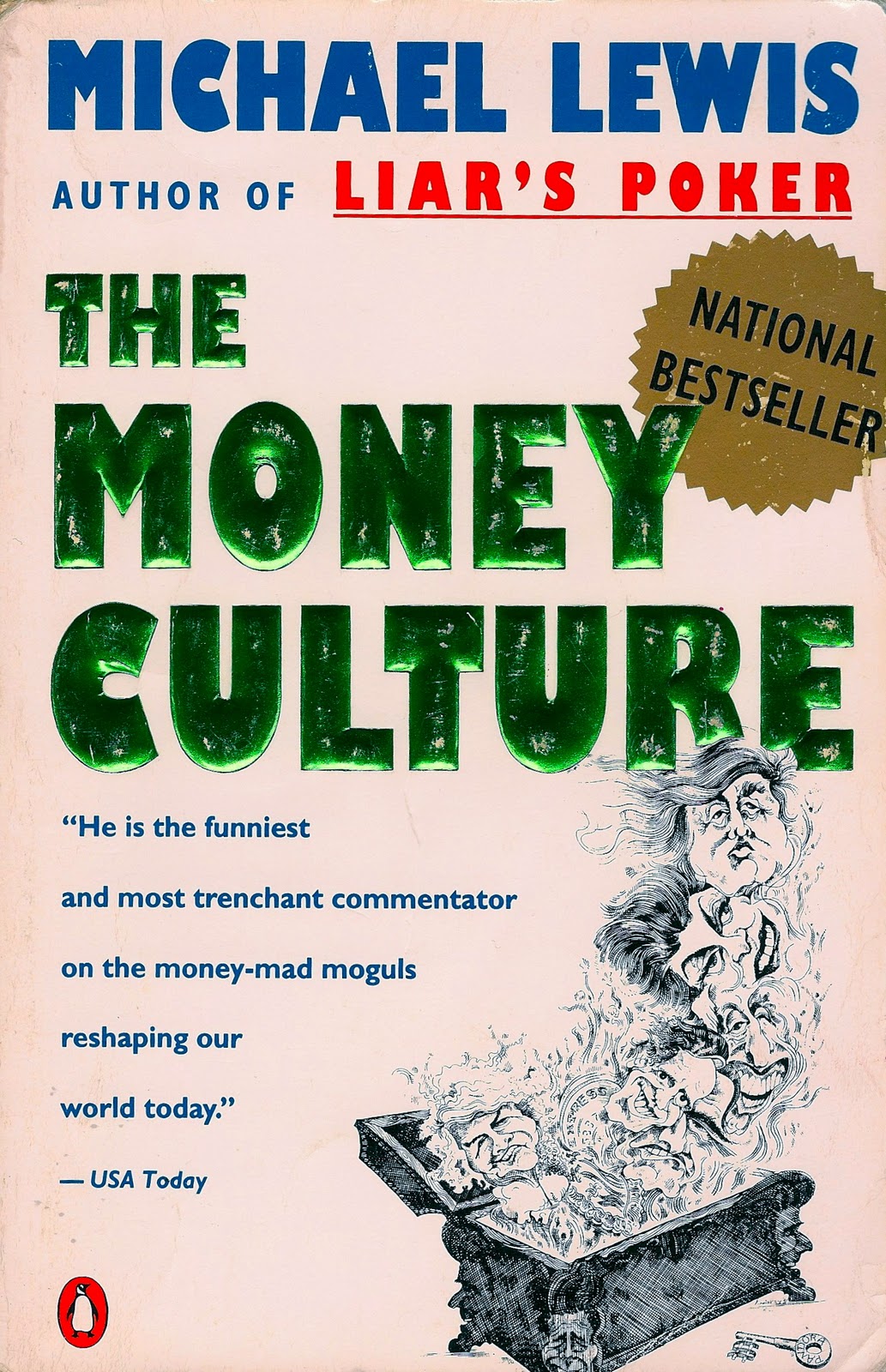
“The Money Culture,” by Michael Lewis, (New York: Penguin Books; 1991), 282 pages.
The Money Culture is a compilation of essays and stories written in the later 1980s and early 1990s for various publications, such as Manhattan Inc., New Republic, The New York Times, The Wall Street Journal – Europe, and The Washington Post. The book was published in 1991, and appears to attempt to capitalize on Lewis's success with his very successful first book Liar's Poker, a tell all account of his brief career as a Wall Street bond salesman.
The Money Culture is arranged into three parts. The first part, "New World," examines the new world of modern finance from a variety perspectives, namely, a critique of the absurdity of mass marketing the American Express card as a symbol of exclusivity, to a series of commentaries on the then largest ever leveraged buy-out (the purchase of RJR Nabisco by leveraged buy out firm Kohlberg Kravis Roberts). Lewis gives a glimpse into the democratization of retail investing through his participation in an expensive cruise to the Amazon where customers will be given investment tips and ideas from a host of a television program about investing. We learn how the major new beneficiaries of the new money culture funded by debt are investment bankers educated at the "best school" (meaning Harvard, Wharton, Stanford etc). We also get a glimpse into the future when Lewis states that the late 1980's corporate expansions and corporate takeovers were predominantly funded by debt fund sourced from outside America. So great was the growth in debt that Lewis quoted a Princeton economics professor who made a strong case that the leveraging of corporate America would end in tears. That professor was quoted as stating that the last time we had debt in this range was in the 1920's. The professor is Benjamin Bernanke, the same man that is presently the Chairman of the New York Federal Reserve.
The second part, "Old World," contains essays on the spread of the new model of American-style, debt-fueled business activity to the old world of the United Kingdom and Europe. These stories demonstrate the manifestation of the new, brash, avarice in places where a go-getter graduate from Oxford or Cambridge with fire in the belly and a bit of hard work and a bit of leverage make a fortune as an investment banker, just like his Harvard and Stanford contemporaries.
Part three, "Other World," is a selection of essays about Japan's influence on global finance, how its savings underwrite the West's debt binge, and how it all could come undone in the West if there is another massive Tokyo earthquake and global savings are repatriated to Japan.
The Money Culture is one of two books that mark the beginning of Lewis's career as a writer. The 2010 book The Big Short is his examination of the collapse of the credit bubble. Lewis saw both the end of the credit bubble, and the beginning, so these two books complement each other quite nicely. Although its been over 20 years since these essays were written, The Money Culture marks a useful historical resource on how things were when the credit boom started, how outrageous the behavior and actions were at the beginning and at the end, and how by comparison after two decades these events in comparison ht deals seem so small, and the numbers miniscule and activities somewhat quaint. We are now used to financial scandal and endemic bad behavior that it flows over us like water off a duck's back. We are the poorer for it. The Money Culture is also a timely reminder to us as a mile marker on the road to the insolvency of the West and the financial armageddon potentially facing the United States: The Money Culture shows us that things weren't as bad as they are now, and with a bit of clear thinking and foresight, all (or a lot of) the present problems facing the world could have been avoided or ameliorated.
The Money Culture has passed the test of time. it is well written and covers topics relevant today. Some of the people featured are known to us today, and others are now forgotten, captured here at their moment of their greatest impact when their impact was at its peak. This also serves as a kind of colorful financial history of the mid to late 1980s, a passing parade of colorful characters the like of which we will not see again, not right away, but for perhaps fifteen to twenty years or do.


 , may have been an attempt to say something like, “I hope that college students trying to decide what to do with their lives might read it and decide that its silly to phony it up, and abandon their passions or even their faint interest, to become financiers.” Lewis admits that his message in Liars Poker was mainly lost on his readers, and that most students read Liars Poker as a “how to" manual. One wonders, given his failure to get his message across in Liar’s Poker, whether The Big Short will be read as a "how to" manual for aspiring contrarian hedge fund managers, rather than a vindication of Lewis’s views that the boom era of high finance (and its associated excess and insanity) is over. Like a dog returning to its own vomit, Lewis covers the same fertile ground in The Big Short that he covered in Liar’s Poker, and in some instances the same people he used to work with. I wonder if the sins of Liar's Poker are being repeated on a larger scale in The Big Short (except with much larger sums of money). I wonder whether the bright kid from Ohio State who reads The Big Short will be encouraged to become, say, an oceanographer and spurn the offer from Goldman Sachs and set out to sea. It would take an exceptional young person to reject such temptation. When given a choice between a bucket of money and ocean spray in the face, most young people would chose the bucket of money. But our scorn for the choices made by young college graduates could equally be made against successful authors. Lewis is free to write about anything he wants. He has written about the grubby “low-art” of finance, as well as comparatively more noble and uplifting subjects in Moneyball and The Blind Side. Perhaps Lewis will return to sharing the uplifting stories he is clearly capable of writing, and avoid the temptation to return to the field of finance, which, according to his past experience, seems to encourage bright young kids from Ohio State to go to work at Goldman Sachs.