Showing posts with label Investing. Show all posts

Adventure Capitalist: The Ultimate Investor's Road Trip, by Jim Rogers


Jim Rogers, "Adventure Capitalist: The Ultimate Investor's Road Trip," (Random House: New York; 2003), 357 pages.


Jim Rogers, former hedge fund manager, likes to travel. His first book, Investment Biker, recalled his around-the-world trip by motorbike. This book, Adventure Capitalist, is a sequel. It’s an account of his travel around the world by car, a trip that took 3 years. He and his wife made a trip in a customized four wheel drive Mercedes sports car. The journey started in Iceland and continued through the U.K., Southern Europe, Central Asia to China, Japan, Russia, Scandinavia, the east and west coast of Africa, Australia, New Zealand, South America, Central America, and through the USA to Canada and Alaska.


Like Investment Biker, this book is more than a travel book. It contains description of the author’s travels, as we would expect. More interestingly, it contains Roger's opinions on many of the countries he visited, such as whether it was blighted by corruption or poor governance. He is particularly expansive on various countries' financial condition, whether the country’s currency was being debased, and if conditions were optimal for improving the lives of that country’s citizens. As much as he comments on the counties he visits, Rogers also devotes considerable space to reflect on life in the United States and its place in the world. Rogers is an optimistic libertarian, and his travels force him to reflect on US policies, such as foreign policy, foreign aid, various international institutions (such at the World Bank and the International Monetary Fund), and domestic economic policies. These reflections are frequently critical, but are neither theoretical nor polemical, but based on his understanding of the world and various nations gained from his unique perspective as an extensive global traveler.

Roger's investment philosophy is unorthodox, as is his commentary on socio-political situations. His views are rooted in his on the ground observations gained by going into the field where there are few, if any, 5 star hotels. His experience at school, college and business taught him that experts were usually wrong, hence his bias towards learning for himself through his own experiences. His travels are characterized by the slaughter of sacred cows (meaning conventional views), the puncturing of various balloons and the laying to rest the ore-conceptions of the world held by certain "authorities," many of whom have never left home (p.4).

A strength of this book is the recollection of his journeys through a large number of countries he visited; however, this also restricts the author from writing about every country in detail. Some countries are covered in great detail (China) while others are barely mentioned. This limitation sometimes comes across as the story being rushed.  At times, the great distances being covered through exotic locations barely rate a mention.

The book excels in other areas. First, it exposes a few myths about the international travel in Africa and South America, and demonstrates that with ingenuity and determination that it is possible to drive a car around the world. Second, he exposes a few myths and pre-conceived notions about African countries and their government’s economic policies, the causes of poverty and misery, and the causes of prosperity and economic growth – here’s a hint, it not United Nations aid projects. Rogers observes in such a way and with a view to seeing conditions that will encourage profitable investing. Third, Rogers reflects on the USA. His unique perspective of travelling around the world gives him perspective to comment on conditions in the USA, and to reflect and make prediction about the USA’s future. Anyone with more than a passing interest in travel, the USA’s place in the work, and

This book is more than a travel book. It’s a reflection on life, the world, and the place of the USA in the world, and assessing foreign countries as places to invest should enjoy this book.

"Investment Biker: Around the World with Jim Rogers," by Jim Rogers


Investment Biker: Around the World with Jim Rogers, (Hollbrook, MA: Adams Media Corporation; 1994), 402 pages.

From March 1990 through August 1992, the author and his girlfriend travelled around the world on their BMW motorcycles. Starting in New York City, they flew to Ireland and travelled through southern Europe to China and Japan, then turned around and went through northern Europe back to Ireland. They then drove the length of Africa from north to south, almost circumnavigated Australia, rode through New Zealand,  rode through the Americas from Cape Horn in the south to New York in the north east through to Anchorage, Alaska, traveling a total of 65,000 miles. The book is a record of his travels including observations of the countries he visited. Most but not all of the book is devoted to his travels. We learn of the difficulties of riding a bike around the world though conditions ranging from first class roads to bumpy dirt tracks. The book also casts a keen observer's eye at the countries through which he travels. He comments on the living conditions of every country he visits, and gets to the heart of what makes each country successful or unsuccessful. As a professional investor, Rogers also comments on the economic conditions of many countries, primarily based on his observations and interactions with the people he meets. He gets to the heart of what makes a county successful, what makes life good for its citizens, what makes currencies more valuable, and others less valuable. In light of his observations about the countries he visits, he returns to a repeating theme, namely the similarity between the direction of the U.S.A.'s economy and that of failed third-world countries around the globe.

This is a gem of a book. It is s both a record of an amazing round-the-world motorcycle trip, and a reflection on what makes a country successful. Rogers's analysis and writing is direct and honest. It is  unencumbered with flowery introspection or self-doubt. It is full of practical advice and commonsense for the traveller and to a lesser extent the international investor.  If the book has a weakness its his failure to give any detailed observations of his travels through the United States. He also writes comparatively little of his travels through Australia. This limited treatment of two large countries surprised me. I think the book is the poorer than it could have been due to so little coverage of these large countries. Nonetheless, this is a very good book that should be enjoyed by readers interested in travel, investing, and motorcycle travel journeys.

"Warren Buffett and the Art of Stock Arbitrage," by Mary Buffett and David Clark


"Warren Buffett and the Art of Stock Arbitrage," by Mary Buffett and David Clark, (New York: Scribner; 2010), 153 pages.

This book is another addition to the expanding category of books about Warren Buffett's approach to profitable investing. The unique feature of this book is that one of the authors shares the surname of the subject (because she was once married to one of his sons). This small book explains arbitrage, with occasional references to actual Buffett arbitrages. It also goes over topics of interest to the novice investor, such as what arbitrage is, types of arbitrage, how it can be used with great certainty to increase annual investment returns, how leverage (or borrowings) can greatly improve investment returns when it is used effectively (and the opposite - risk of loss or low profits in certain situations) and overviews of various real-world examples where Buffett used arbitrage to earn outsized investment returns. For example, the authors discuss the following:

·               friendly mergers
·               hostile takeovers
·               buy-backs and self-tender offers
·               corporate liquidations
·               corporate spin-offs, and 
·               stubs.

This is not a book for experts; on the contrary it is an introductory book on the subject of arbitrage. Experts should by-pass this book for I doubt they will benefit from the contents. It is mostly a book for novices on how arbitrage situations can be very profitable if executed properly. The spice or spin is added by the references to Warren Buffett through frequent reference to his success as an arbitrager, and example of situations were he profitably engaged in arbitrage. The message of the book is that the reader can profit, just like Warren Buffett, if you follow the guidelines provided in this book.

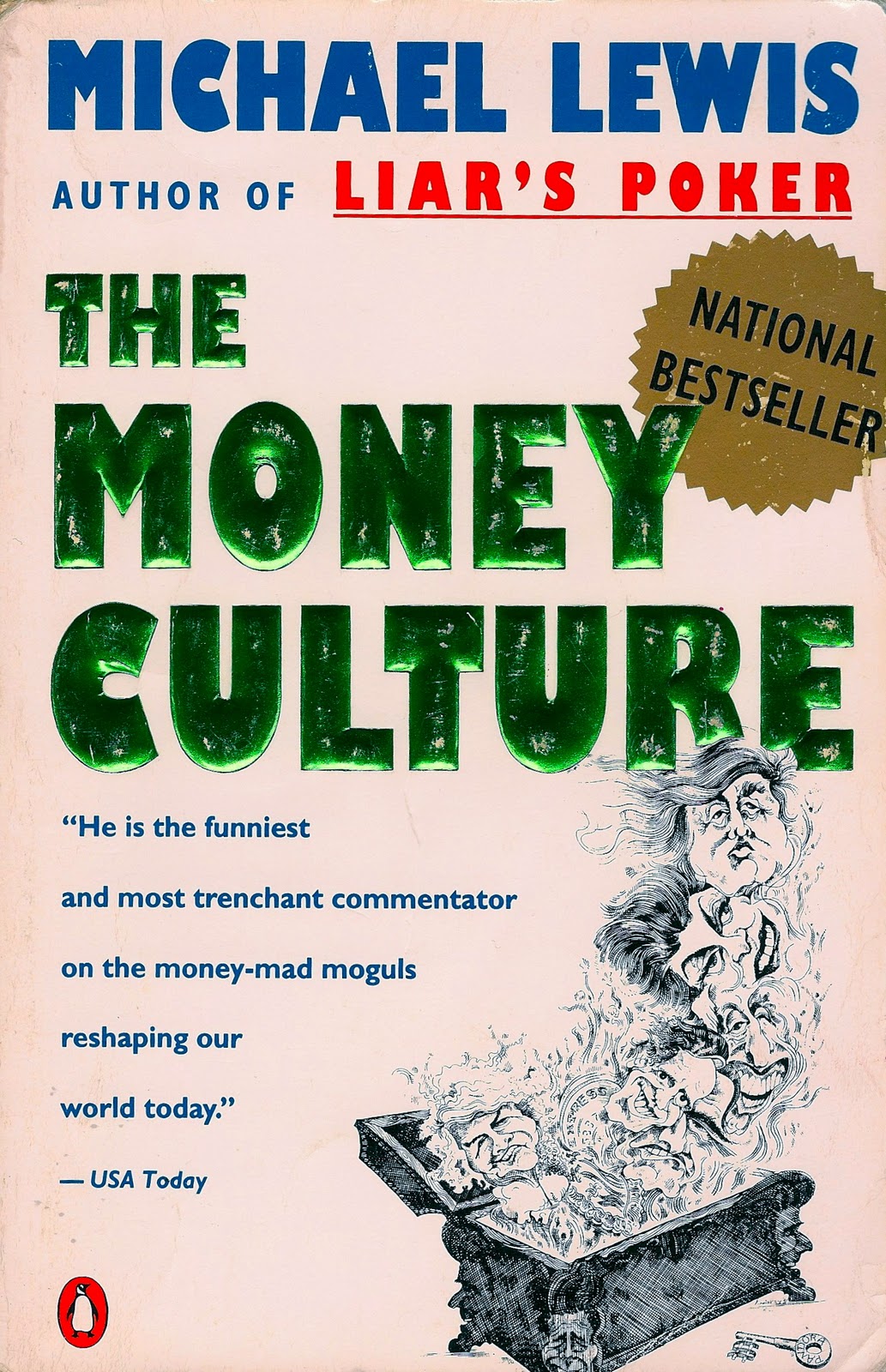
“The Money Culture,” by Michael Lewis


“The Money Culture,” by Michael Lewis, (New York: Penguin Books; 1991), 282 pages.

The Money Culture is a compilation of essays and stories written in the later 1980s and early 1990s for various publications, such as Manhattan Inc., New Republic, The New York Times, The Wall Street Journal – Europe, and The Washington Post. The book was published in 1991, and appears to attempt to capitalize on Lewis's success with his very successful first book Liar's Poker, a tell all account of his brief career as a Wall Street bond salesman. 

The Money Culture is arranged into three parts. The first part, "New World," examines the new world of modern finance from a variety perspectives, namely, a critique of the absurdity of mass marketing the American Express card as a symbol of exclusivity, to a series of commentaries on the then largest ever leveraged buy-out (the purchase of RJR Nabisco by leveraged buy out firm Kohlberg Kravis Roberts). Lewis gives a glimpse into the democratization of retail investing through his participation in an expensive cruise to the Amazon where customers will be given investment tips and ideas from a host of a television program about investing. We learn how the major new beneficiaries of the new money culture funded by debt are investment bankers educated at the "best school" (meaning Harvard, Wharton, Stanford etc). We also get a glimpse into the future when Lewis states that the late 1980's corporate expansions and corporate takeovers were predominantly funded by debt fund sourced from outside America. So great was the growth in debt that Lewis quoted a Princeton economics professor who made a strong case that the leveraging of corporate America would end in tears. That professor was quoted as stating that the last time we had debt in this range was in the 1920's. The professor is Benjamin Bernanke, the same man that is presently the Chairman of the New York Federal Reserve.

The second part, "Old World," contains essays on the spread of the new model of American-style, debt-fueled business activity to the old world of the United Kingdom and Europe. These stories demonstrate the manifestation of the new, brash, avarice in places where a go-getter graduate from Oxford or Cambridge with fire in the belly and a bit of hard work and a bit of leverage make a fortune as an investment banker, just like his Harvard and Stanford contemporaries.

Part three, "Other World," is a selection of essays about Japan's influence on global finance, how its savings underwrite the West's debt binge, and how it all could come undone in the West if there is another massive Tokyo earthquake and global savings are repatriated to Japan.

The Money Culture is one of two books that mark the beginning of Lewis's career as a writer. The 2010 book The Big Short is his examination of the collapse of the credit bubble. Lewis saw both the end of the credit bubble, and the beginning, so these two books complement each other quite nicely. Although its been over 20 years since these essays were written, The Money Culture marks a useful historical resource on how things were when the credit boom started, how outrageous the behavior and actions were at the beginning and at the end, and how by comparison after two decades these events in comparison ht deals seem so small, and the numbers miniscule and activities somewhat quaint. We are now used to financial scandal and endemic bad behavior that it flows over us like water off a duck's back. We are the poorer for it. The Money Culture is also a timely reminder to us as a mile marker on the road to the insolvency of the West and the financial armageddon potentially facing the United States: The Money Culture shows us that things weren't as bad as they are now, and with a bit of clear thinking and foresight, all (or a lot of) the present problems facing the world could have been avoided or ameliorated.

The Money Culture has passed the test of time. it is well written and covers topics relevant today. Some of the people featured are known to us today, and others are now forgotten, captured here at their moment of their greatest impact when their impact was at its peak. This also serves as a kind of colorful financial history of the mid to late 1980s, a passing parade of colorful characters the like of which we will not see again, not right away, but for perhaps fifteen to twenty years or do.

"Automatic Millionaire," by David Bach


“Automatic Millionaire: A Powerful One-Step Plan to Live and Finish Rich,” by David Bach, (New York: Broadway Books; 2004), 237 pages.

"Automatic Millionaire" has a simple message: anyone can follow a few simple steps and retire as a millionaire. The first tip is to live within your means, which can be restated as don’t spend more than you earn. This becomes easier than you think if you omit wasteful spending habits, such as the daily latte/cigarettes/purchased lunch. Bach shows how eliminating these types of spending, when continued throughout an entire working life can, with compounding and prudent investing of the savings, grow to over $1 million over a lifetime. The final amount accumulated will be large the more you save and the earlier you start saving.

Bach’s second tip is to save for retirement automatically in pre-tax dollars every time you get paid. Saving in pre-tax dollars (using one of the tax deferred saving plans such as 401K, 457 etc) can quickly multiply your savings when investing pre-tax dollars, particularly when you have an employer that matches your contribution. Bach emphasizes that pre-tax automatic saving is the key. By investing pre-tax money the amount you invest and accumulate over your working life is greater than if invested from taxed money.

Bach’s third tip is to have a rainy day fund or emergency fund. Sometimes life brings large unexpected events, such as unemployment or large medical expenses. Bach states that the best way to manage such events is to have an emergency fund or cash reserve equivalent to at least 3 to 6 months of expenses. To his credit, Bach also provides readers with tips for finding secure places in which to keep an emergency fund, such as at-call high interest bank accounts, high interest deposits, and certain U.S. Treasury instruments.

The forth tip Bach gives is for readers to make their monthly mortgage payment obligation in two two-weekly payments. By paying the same monthly total in two installments two weeks apart, a homeowner can pay off their home a lot earlier (by almost 7 to 10 years) and reduce the total amount of interest paid to their bank over the life of the (now reduced term) loan. This simple task enables a homeowner to retire their debt much earlier, lower their total interest payments, and enable the homeowner to invest the money previously allocated to repaying the mortgage.

Bach’s fifth tip is to tithe or donate money to charitable or religious causes. Not only does the donation benefit the receiving organization, but it also is, in many instances, tax deductible.

Bach’s book is targeted to people interested in improving their financial position. His advice is sensible, and the implementation strategy (establishing once-off automatic savings, investment and mortgage repayment plans) easy to implement. The book is a good introduction for people interested in securing their financial security. Bach nicely shows how his strategy works for all income levels. He gives a real-life example of how using this strategy, a couple earning $40,000 per year, owns two paid off houses, and has investments approaching $1 million. To some readers, Bach’s message maybe familiar, or may have been made by other writers or personal finance advisers. This is probably good news as it endorses the strategy. It is a powerful message told in an accessible and non-technical style. It is a fine guide to convince and help regular workers on any income to live within their means, and to set up automatic plans that will ensure that anyone can become a millionaire at retirement.

A Life In Progress, by Conrad Black


“A Life In Progress,” by Conrad Black (Toronto: Key Porter Books; 1993), 522 pages. ISBN 1-55013-520-1

Overview

A Life In Progress is the first volume of Canadian newspaper proprietor Conrad Black’s autobiography. At time of publication, Black was aged 49 years, and seeming at the peak of his profession as the proprietor of a global newspaper publishing business. The book account’s for Black’s rise from privileged Canadian child, through to his numerous educational and business successes to him attaining his position as a global media magnate.

Black provides the reader with an extremely detailed account of his privileged and successful life. Born into a wealthy Canadian business family, Black enjoyed the numerous privileges afforded a family of their status. He was educated at private schools. His family had the means to enjoy summer vacations abroad, occasionally in Europe. He was a child and youth accustomed to socializing and dealing with other wealthy people, and Canadian citizens of influence. He attended college, and during that time made the acquaintance of numerous judges and politicians that he encountered during his regular card playing sessions. He later earned a law degree, and subsequently set out, without confidence, to become a newspaper proprietor. He used the tactic of financing his newspaper purchase by going into debt, and quickly repaying that debt by turning around the paper’s finances by aggressively cutting costs. So successful was his method, that he employed it over and over again until he owned a chain of Canadian newspapers. He employed the same method to take control of Argus Corporation, a venerable Canadian industrial company best knows for its subsidiary Massey Ferguson, the tractor manufacturer. His successful enterprises were replicated in the United States, Great Britain and Australia. At the time of his writing A Life In Progress, he owned or controlled the companies that published London’s Telegraph, The Jerusalem Post, The Chicago Sun Times, The Sydney Morning Herald, and a large chain of papers serving suburban and regional areas of North America.

Among all the frenetic coming and goings of his wide-reaching business activities, Black retained a constant devotion and support of conservative politics. Originally his participation and support was confined to Canada, however, as he business expanded to the United States and Great Britain, his influence in conservative politics likewise expanded. He was an acquaintance of Presidents of the United States, as well as the Prime Minters of both Great Britain and Canada.

Black says that the story of his life, up to that date, is also the story of Canada. I’m not sure if Black’s claim to equivalence is appropriate. Nonetheless, the story of his life is a very good illustration of how a person with a good head start in life, born into his position in life, can use his connections and acquaintances to advance his career.

Black also appears to have been blessed with the ability to be a savvy judge of character. He uses his ability quite deftly to his advantage in numerous business negotiations.

Black also devotes a lot of his book to the problem of the French-speaking Canadian province of Quebec, and its fractured and difficult place within the Canadian Federation.

We are also given brief glimpses into Black’s personal life, including his courtships, marriages, and his conversion to Roman Catholicism in the 1980’s.

A notable feature of Black’s book is the astounding level of detail. Black must have a near perfect recollection of conversations, meeting and phone calls going back almost 30 years. He must have a remarkable memory, or very good diaries to include such detailed and intimate conversations.

The book is also illustrative of what it takes to become a successful global newspaper proprietor, namely confidence, self-assurance, a bit of luck and drive. It also helps to be born into a family of wealth, and have access to the highest level of government and connections and acquaintances with people able to provide debt financing.

If this book has a weakness it is its “Canadian-ness;” many of the political tales and business dealings within Canada may not resonate with non-Canadians, or people unfamiliar with Canadian politics and businesses. A great deal of Black’s comments and lessons on Canadian politics were lost on me because of my general ignorance of Canadian history and politics.

Black also has a tremendous command of the English, which he puts to use with great effect. He knows a lot of big words, and he doesn’t hold back in using them, especially when criticizing another person’s character. His colorful turn of phrase is at times entirely appropriate, while at other times, arguably borders on showing-off. This may not endear him to some readers.

Another of the book's weakness is Black's rather superficial explanation of his conversion to Roman Catholicism. He gives an explanation, but it is seems to be lacking. When dealing discussing matters of eternity, or the salvation of his soul and where it will reside during eternity, Black does not evangelize by giving a detailed and lengthy account of his spiritual conversion. He devotes many more pages to his business dealings than he does to his conversion. This is curious to say the least. Perhaps there’s another detailed book yet to be written on this subject.

This book should be of interest to Canadians, readers with interest in general business and investing, newspapers proprietors and their staff, conservatives, and people interested in what it takes to build a global business operation.

"The Big Short: Inside the Doomsday Machine," by Michael Lewis


“The Big Short: Inside the Doomsday Machine,” by Michael Lewis, (New York: W. H. Norton & Company Ltd; 2010), 266 pages.

The Big Short tells the story of a select group of individuals that foresaw and profited from the 2008 collapse of the United States’ property bubble. Lewis identifies the cause of the collapse as cheap housing finance funded initially by reckless bank lending, where loans were converted into mortgaged-backed securities (bonds) and a variety of derivative products designed to enable “Wall Street” to profit from over indebted lower and middle class Americans. Lewis’s book tells the story of certain individuals that saw the long term foolishness (at best) or insanity (at worse) of this behavior, and how they were able to profit handsomely, both for themselves and their investors. Lewis tells the story from the vantage point of a number of such investors. We learn of the lawyer turned investor who was once an equities analyst specializing in sub-prime lenders who figured out how to short specific mortgage-backed bonds. We read about the west-coast physician who gave up practicing medicine to run a hedge fund and make hundreds of millions of dollars for his investors by almost single-handedly discovering a way to profit from the collapse of house prices. We learn of the man responsible for selling derivatives to investors, such as the ex-lawyer and former physician, and how the salesman’s own firm let him sell what was basically insurance on mortgage-backed bonds without any company capital backing the risks (i.e. they never thought the housing bubble would burst, and therefore not have to pay any claims). We also learn of two friends in California who go from part-time investors to multi-millionaires as they identified and profited from the mortgage bond collapse. Lewis also shows how some other smart investors saw the pending collapse in sub-prime mortgage bonds, and were able to profit very handsomely and the expense of “stupid” banks and other financial institutions, and benevolent regulators that permitted such activity to occur (there was nothing apparently illegal so they were unable to regulate what was beyond the scope of the regulations they enforced).

Lewis’s style of writing tends to be to tell a big story by focusing on a number of individuals and explain the big picture by explaining the actions of a these few participants in the bigger story. In The Big Short, he does an excellent job of showing how some smart people made fantastic fortunes (some as great as tens of billions of dollars) by basically betting that house prices would fall, thereby profiting by the collapse of mortgage backed securities by purchasing derivative contracts that exponentially increased in value with the decline in value of the mortgage back bond from which they were “derived”. We all now know how these activities threatened the solvency of numerous money center banks and the stability of the entire financial system. Lewis shows how the nimble, smart hedge fund guys who went against the herd mentality of the bumbling, establishment institutions, won the day. Hooray for them!

As an analysis of how the smart guys won big, The Big Short is a first rate story told very well. But one has to wonder of the effect of this book on the reading public, particularly those he seeks to influence. Lewis, at heart a moralist; he admits that his first book, Liar's Poker, may have been an attempt to say something like, “I hope that college students trying to decide what to do with their lives might read it and decide that its silly to phony it up, and abandon their passions or even their faint interest, to become financiers.” Lewis admits that his message in Liars Poker was mainly lost on his readers, and that most students read Liars Poker as a “how to" manual. One wonders, given his failure to get his message across in Liar’s Poker, whether The Big Short will be read as a "how to" manual for aspiring contrarian hedge fund managers, rather than a vindication of Lewis’s views that the boom era of high finance (and its associated excess and insanity) is over. Like a dog returning to its own vomit, Lewis covers the same fertile ground in The Big Short that he covered in Liar’s Poker, and in some instances the same people he used to work with. I wonder if the sins of Liar's Poker are being repeated on a larger scale in The Big Short (except with much larger sums of money). I wonder whether the bright kid from Ohio State who reads The Big Short will be encouraged to become, say, an oceanographer and spurn the offer from Goldman Sachs and set out to sea. It would take an exceptional young person to reject such temptation. When given a choice between a bucket of money and ocean spray in the face, most young people would chose the bucket of money. But our scorn for the choices made by young college graduates could equally be made against successful authors. Lewis is free to write about anything he wants. He has written about the grubby “low-art” of finance, as well as comparatively more noble and uplifting subjects in Moneyball and The Blind Side. Perhaps Lewis will return to sharing the uplifting stories he is clearly capable of writing, and avoid the temptation to return to the field of finance, which, according to his past experience, seems to encourage bright young kids from Ohio State to go to work at Goldman Sachs. 

Pilgrimage to Warren Buffett’s Omaha,” by Jeff Matthews


“Pilgrimage to Warren Buffett’s Omaha,” by Jeff Matthews, (New York: McGraw Hill; 2009), 298 pages.


Pilgrimage to Warren Buffett’s Omaha is hedge fund manager Jeff Matthews’s account of his trip to the 2007 and 2008 Berkshire Hathaway Annual General Meeting in Omaha, Nebraska. The book is an expansion and revision of Matthews’s reports previous made on his blog, “Jeff Matthews Is Not Making This Up.” Matthews’s book expands on more than just the Berkshire Hathaway Annual General Meeting. He also writes about his difficulty in getting to Omaha, his impressions of the city, events in Omaha secondary to Annual General Meeting, the comparatively unexciting procedural matters of the Annual General Meeting, and what everyone was in Omaha for, the famous five hour question and answer session presided over by Berkshire Hathaway Chairman and Chief Executive Officer Warren Buffett, and his friend and business partner Berkshire Hathaway Vice Chairman Charles Munger. Much of Matthews’s book is Matthews provides a detailed reconstruction of the question and answer session, where Buffett and Munger answer questions from shareholders, unscripted, and without assistance from lawyers, public relations people, or other types of people you normally see at annual general meeting who seem to have the job of filtering out uncomfortable or embarrassing questions for management. Matthews not only reconstructs the question and answer sessions, but adds considerable background, analysis and commentary based on his extensive knowledge of Berkshire Hathaway, Buffett and Munger, and the various Berkshire Hathaway businesses that he has come to know and study during his three decades as a professional investor. The every-curious Matthews also includes many of his own findings and observations of Berkshire Hathaway gained during conversations with managers, discussions with shareholders, and a visit to one of Berkshire Hathaway’s famous subsidiaries, the Nebraska Furniture Mart. Matthews also includes some difficult and uncomfortable questions that came to him during his 2 visits to Omaha, questions about the entire “Woodstock for Capitalists” experience (a euphemism coined for the Berkshire Hathaway Annual General Meeting) such as the divergence between Buffett’s speeches and sayings and his actions, and the performance of various business units within Berkshire Hathaway and what this says about Buffett’s way of doing business.


Matthews’s great strength in Pilgrimage to Warren Buffett’s Omaha, and what sets it apart from nearly all other books is that he hasn’t bought into the cult of personality that surrounds Berkshire Hathaway, Warren Buffett and Charles Munger. Many books on Buffett tell the story of Buffett’s success (i.e. how to invest like Buffett, how Buffett made his fortune), but few, if any, take a rational and clear eyed view at the subject. Don’t be mistaken in thinking that Matthews’s book is an attack on Buffett: it isn’t. Matthews is full of professional praise for Buffett’s success in achieving unparalleled investment returns, the unique way in which he and Munger handle annual general meetings, and their willingness to identify irrational and foolish conduct in the business community. Nonetheless, Matthews raises some questions of his own that other shareholders failed to ask (in fact, Matthews is somewhat curious that some shareholders ask Buffett and Munger questions unrelated to the performance of the Berkshire Hathaway Businesses (such as “what should I do with my life”). Matthews’s questions include the following.

  • Has Buffett’s tight-fisted or thriftiness impeded the growth of the businesses he owns? How come Nebraska Furniture Mart, a company Buffett purchased about the same time that a one-store Minnesota company changed its name to Best Buy, and since then, Best Buy has grown to 1000 stores with $40 billion in sales whereas Nebraska Furniture Mart has 3 stores and $1 billion in sales?

  • Buffett, who is critical of board executive compensation committees, has been on many boards, but no executive compensation committees. Why hasn’t he asked? What company would risk the publicity of refusing to have Buffett on their executive compensation committee?

  • How has Buffett managed to escape any collateral damage from scandals that occurred on his watch (i.e. the “gallon pushing” accounting anomalies while serving on the board at Coca Cola in the 1990’s, and the criminal prosecution of managers he praised at Berkshire Hathaway subsidiary General Re?

  • How does Buffett, the very rational conservative investor, explain his well-known social progressiveness/liberalness to his predominantly lily-white shareholder audience of ageing baby-boomers?

  • Will Berkshire Hathaway survive in its current form when Buffett passes away?

  • Is Buffett a hypocrite by outwardly praising meritocracies, and opposing inherited dynastic wealth, yet when he buys family businesses he retains family business managers? Did Nebraska Furniture Mart fail to become a national business because it is family run?

  • How can Buffett call derivative financial instruments “financial weapons of mass destruction,” yet he has purchased numerous derivative contracts and claims he will make money on every contract?

  • Buffett likes businesses that aren’t capital intensive, so why has he recently purchased capital-intensive companies such as power utilities and railroads?

Pilgrimage to Warren Buffett’s Omaha is an essential book for the student of Buffett and any person interested in the unique company that is Berkshire Hathaway. Matthews is both full of praise for Buffet and Berkshire, yet does not shy away from raising some difficult and legitimate questions that while acknowledge Buffett as an exceptional or even unique investor, recognize that he too is prone to human foibles, frailty and error. Few books on this subject have done this, and for this reason alone is a reason to buy this book.