Showing posts with label Sport. Show all posts

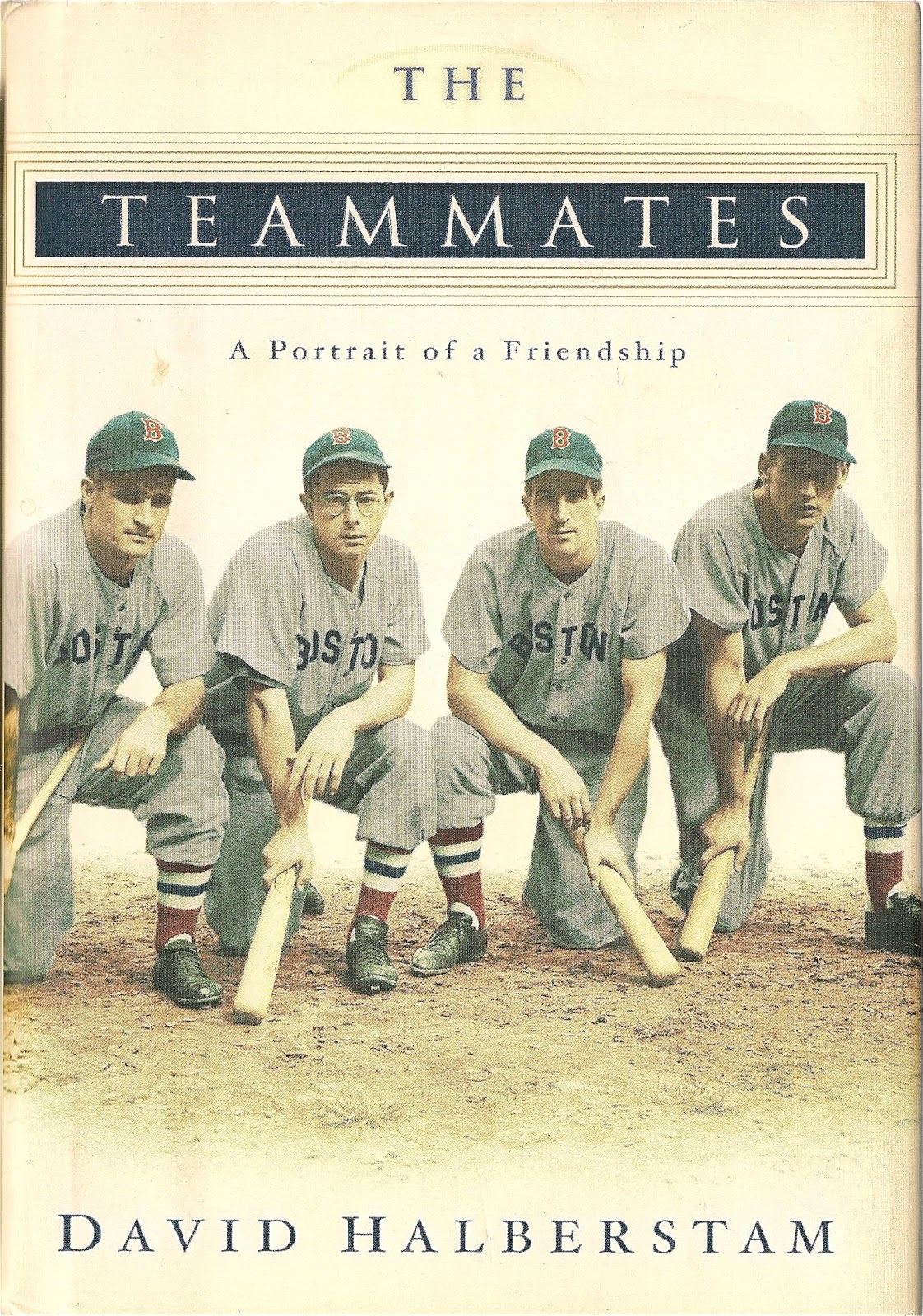
"The Teammates," by David Halberstam


David Halberstam, "The Teammates," (New York: Hyperion; 2002), 217 pages.

This small book is about the enduring friendships between four former professional baseball players (Ted Williams, John Pesky, Dominic DiMaggio and Bobby Doerr). The author provides an oversight of how each started his professional baseball career, how they were recruited to play in Boston, their lives after they finished playing baseball, and the ways in which the friendships continued for the remainder of their lives.

The book benefits a great deal from the author’s love of baseball. He is very knowledgeable of the game, and knows a great deal about these four players from having written a previous book about their famous team the Boston Red Socks. Hence, the obvious appeal of this book to baseball fans. Readers should note that The Teammates is more than just a book about baseball; it’s also a book about friendships and how they endure throughout the years. The author shows us what friends do for each other throughout the years, and what they do for each other in their twilight, more vulnerable years. We also get a glimpse of the lives of professional sportsmen, and how each of the four men made different choices that had significant impacts of the rest of their lives. This dual aspect of the book makes it enjoyable for the baseball fan and the non-fan, or anyone interested in how four men could remain friends for about seventy years.

"That’d be Right: A Fairly True History of Modern Australia," by William McInnes


"That’d be Right: A Fairly True History of Modern Australia," by William McInnes, (Sydney: Hachette Australia;  2008), 320 pages.


That’d be Right by William McInnes is labeled as “a fairly true history of Australia”, a history viewed through the author’s eyes, with a particular emphasis on sport and politics. The author approaches Australian “history” through recollection, primarily his recollections of various sporting and political events, and what he was doing when those events occurred in Australia from the 1970s through to today. McInnes narrates a series of loosely related political and sporting stories. The only relationship or connection that these political and sporting stories have with each other is the author. He connects them via a chain of recollections, observation and anecdotes, that are at time humorous, to attempt to add color and interest to what many people would ordinarily be a rather thin gruel of politics and sport. For example, he recalls his family and friends’ activities during some of the events of his youth (the 1975 Australian Federal election), a famous cricket match (the 1977 Centenary Test), events he watched was in college in the 1980’s (political rallies and other sporting matches/races) through to political and sporting events and cultural events he attended as a spouse and father.

McInnes should be lauded for writing about sport and politics from the vantage point as an interested opinionated outsider, and the impact and influence of these events on people’s lives. Many books about sport and politics are written from the vantage point of the privileged insider (journalists), participants (politician or sportsman), or historians. McInnes’s departure is that he writes about these events that span a period of at least 35 years from his perspective, while liberally garnishing it with side stories and anecdotes, much in the same way that made his earlier book such an enjoyable read. The effect is to produce humorous insights, emotional events and sentimental recollections of people’s lives during momentous events in Australia’s recent past. Unfortunately, the attempt at a so-called “fairly true history of Australia” (which may just be a marketing ploy) comes across, at times, as half-baked. At times it reads as a quickly cobbled together collection of stories loosely woven around a theme of sport and politics in a way to cash in as a follow-up to his superior first book.

McInnes is a fine storyteller and should be applauded for memorializing his recollections; however, given that McInnes places himself in the center of events (and his recollection of events) in this book, it is surprising that we know so little of our author. He comes across as somewhat two dimensional. Apparently McInnes is a well regarded actor, and has had some success on both the stage and screen (both movie and television). This success is alluded to but never addressed; it’s as though it’s assumed or taken for granted that if you read William McInnes’s books, you know who he is, and of his acting career. Many readers do not, and may even wonder aloud when reading this book, who this author is and why his views are important enough to read, if at all? Maybe it’s modesty that keeps McInnes from writing about his career achievements in his chosen profession. Or maybe it’s a wish for privacy, or a male preference to discuss manly things like politics and sport. It seems odd though that in a book about essentially about his recollections of major sporting and political events of the past 35 years that he fails to tell the reader about his rise from struggling acting student in Western Australia to established and accomplished stage, film and television actor.

Despite these minor quibbles, McInnes has written a fine book that should resonate with every lover of good, fresh stories based on the observations and conversations of ordinary suburban people. The only thing that this book lacks is the story of McInnes’s career. No doubt he could have enhanced this book with the details of how he became an expert in his chosen profession. No doubt it would be a story worth telling, and when told by McInnes, be entertaining and a useful guide as well as an account of lessons he learned in establishing himself in a most competitive profession. I suspect that he is leaving those stories for another book. Let’s hope he takes the time to writes it one, because if it is like this book, and his previous book, it would be a humorous and enjoyable read.

No Bull: From the Bush to the Baggy Green, by Andy Bichel


No Bull: From the Bush to the Baggy Green, by Andy Bichel,
(Sydney, Australia: ABC Books; 2009), 246 pages.

No Bull is a light and breezy account of Andy Bichel’s life as a cricket player. The book is a recollection of the author’s rise from school boy player in the Lockyer Valley west of Brisbane Australia, through various State and national representative teams. The author recalls his struggles, as well as the help he received from kind souls along the way, and, once he reached the highest levels of the game, the difficulties he faced in staying competitive at that level.

Bichel’s book is an easy-going read, accessible to young and old alike, but, on balance, perhaps unlikely to hold much interest for people not interested in cricket, especially Australian cricket in the 1990’s and 2000’s. The most engaging aspect of Bichel’s book is his demonstration that success can come from persistence. Bichel was regularly disappointed when left out of the starting and touring line-ups of various teams. On the occasions when he was unexpectedly brought into the team due to another player suffering an injury, Bichel often had stand-out and match-winning performances. Bichel was persistent and patient so that when an opportunity came along, he made the most of it. This perhaps is the most compelling aspect of Bichel’s book: persistence, patience and opportunity, when combined, can produce outstanding, spectacular and often career-best results.

First Tests: Great Australian Cricketers and the Backyards that Made Them, by Steve Cannane


First Tests is a book about how Australia’s greatest cricketers developed their unique and special skills at home in the backyard. The book contains a series of articles on how players developed individual strengths and skills playing in the backyard, and how the backyard’s location, design and the proximity of windows influenced the development of players’ skills. It is these skills developed over thousands of hours after school and on weekends in the back yard (rather than attendance at professional training camps and academies) that made them great players.

The genesis of this book was a suburban Sydney cricket match where the author observed a team mate make an unorthodox but effective batting shot that both infuriated the bowler and provoked conversation among his team mates. When questioned about the origin of the unorthodox batting shot, the team mate answered that he developed it as a kid playing in his parents’ backyard. In that backyard, the player had to adjust his batting shots to avoid breaking windows. The team mate played shots to avoid breaking windows in the backyard, and continued to play them on the cricket field. As the conversation went around the other players at that suburban cricket match, it seemed that every player had a similar story of a strength or weakness that could be attributed to backyard cricket. This got the author to think that if this is the case for ordinary suburban grade cricketers, then it must be the same for elite cricketers. In a sequence of chapters discussing one cricketer, the author explains in delightful detail how many elite cricket players down through the decades developed their skills in their backyard.

For example, Sir Donald Bradman’s unique batting grip, stance and back lift was developed during batting practice with a golf ball and cricket stump. These unique qualities were developed in response to the speed at which the golf ball rebounded off the water tank stand in his backyard. Greg Chappell’s trademark batting shot, a flick off the hip, was invented in his backyard, where the best opportunities for scoring were on the leg side. Alan Davidson bowled accurately because he had to; as a kid bowling in the backyard, if his bowling missed the stumps on his home-made pitch, he had to chase the ball down the hill into the scrub. Doug Walters played spin bowling with ease because his crushed ant bed home made cricket pitch spun like a top. Neil Harvey developed excellent footwork by playing cricket in the back lane where the ball bounced viciously off the cobblestones. Adam Gilchrist, a powerful and clean hitter of the ball, developed that skill in his backyard batting net where at the end of each daily practice he spent time doing what was natural to him, just hitting the ball.

Cannane also elaborates on the type of discipline needed to become an elite cricket (and buy implication an elite player or competitor in any sport). Those that reached the highest level of the game were veterans of thousands of hours of backyard games, often played against older and more experienced siblings and friends. In these contests players developed their competitive instincts and unrelenting desire for success.

Cannane’s book is an enjoyable and light-hearted reflection on the theme of how childhood habits, developed and practiced for thousands of hours in competitive and determined backyard matches developed skills that helped various players reach the highest level in the sport of cricket. These backyard matches played after school and on weekends (and even in winter) were essential in the formation of many fine cricketers. Cannane’s view is that backyard cricket matches will also be instrumental in the development of the future generations of great players. Cannane has also done a great service by including a detailed bibliography containing the publishing details of many biographies and autobiographies of Australian cricketers. This bibliography alone is worth the purchase price of the book because it gives any cricket lover an instant and accessible first reference source for book by and about Australian cricketers.

The Great Fletch by Hugh Lunn


The Great Fletch: The Dazzling Life of Wimbledon Aussie Larrikin Ken Fletcher, by Hugh Lunn, (Sydney Australia: ABC Books; 2008), 355 pages.


This is a sympathetic biography of Australian tennis “great” Ken Fletcher, written by Fletcher’s childhood and life-long friend Hugh Lunn. The book memorializes the childhood, tennis playing successes, disappointments, adventures, and post-tennis life of the man that had the “most beautiful forehand in the world.”

Hugh Lunn’s biography of almost forgotten and overlooked tennis player Ken Fletcher shines a sympathetic light onto the late tennis player’s life. Lunn had an advantage writing this book: he knew Fletcher from childhood. Both grew up on the same street in Brisbane, Australia. They attended the same school, church, and even resided together in Hong Kong in the 1960’s. They remained good friends until Fletcher succumbed to cancer in 2006. The Great Fletch, therefore, is liberally peppered with Lunn’s personal observations and recollections, along with those gathered from Lunn’s interviews with Fletcher’s extensive world-wide collection of friends and acquaintances.

Lunn’s purpose is to remind us of the varied and charmed life of one of tennis’s great players. Born in Brisbane, Australia, Fletcher, the only son of a train driver, had a gift for tennis. This gift was nurtured on a back yard tennis court, and displayed throughout the world. His ability and achievements were so prodigious that in 2000, Wimbledon, the home of tennis, recognized Fletcher as one of Wimbledon’s great players of the 20th century. He partnered with Margaret Court/Smith to do what no other team has achieved by winning the Grand Slam of mixed doubles (i.e., winning the mixed doubles title at the French Open, U.S. Open, Wimbledon and Australian open in the one calendar year). He also won the Wimbledon Doubles title with John Newcombe, and many other tennis titles, as well as being a member of an Australian winning David Cup team. Sadly, it is only the achievements of Fletcher’s contemporaries that we remember, contemporaries that include Rod Laver, John Newcombe, Tony Roche, Roy Emerson, Ken Rosewall, and others. It is hard to stand out, let alone be remembered, among such notable contemporaries.

Lunn’s book shows Fletcher as a man who loved life, enjoyed meeting people, and looking after them. He was at ease with the rich and famous, as well as the poor and downtrodden, and used his friendships with the wealthy to do good. Despite all his tennis successes, Fletcher considered his life a failure because he failed to win the Wimbledon men’s singles title (he lost 3 times to the ultimate champion). This is a harsh self-assessment. Tennis may have been his profession, but his vocation, ultimately, was helping others. His greatest legacy may be his introduction of Chuck Feeney to Australia. Fletcher maintained a friendship with Chuck Feeney, who, 30 years after their meeting in Hong Kong in the 1960's later would be a billionaire philanthropist seeking to give away his fortune. Fletcher’s long list of friends and acquaintances helped Feeney do just that. At the time of his death, Feeney had donated $350 million to charitable medical-research related causes in Fletcher’s home town, something that would never have happened if it was not for Ken Fletcher’s influence.

Lunn’s biography is a fine memorial to his friend’s memory. It is neither referential nor iconoclastic, but a humorous, realistic and honest portrait of his friend’s success and failures – if they could be called that. Fletcher was not only a great tennis player; he was wonderful person that always tried to do good by being a great and loyal friend and acquaintance to many throughout the world, and that is something definitely worth remembering.
The Don: A Biography by Roland Perry


Roland Perry’s “The Don” is a biography of Donald Bradman's exploits as the world’s greatest cricketer. It is a detailed, comprehensive account of his performance on the cricket field as a boy, through to his retirement from the game as a player, selector and administrator. The breadth and depth of Perry’s book are astounding – it’s almost an annotated narrated almanac. The author’s intention is to comprehensively and exhaustively detail Don Bradman’s cricketing achievements. It is through observing these achievements and Bradman’s conduct while achieving them that we learn something of the character of this private, competitive man of exceptionally rare talent and ability.

Perry’s book’s greatest strength is his coverage of Bradman’s entire cricketing career. By obtaining Bradman’s co-operation in the production of the book, Perry explains in exquisite detail Bradman’s childhood encounters of the game, his first schoolboy innings, as well as notable club, State, invitational and national team batting and bowling performances. We learn of the origin of his unorthodox batting grip, his exceptional concentration, relentless domination of all forms of bowling that broke many batting records, both in terms of the runs scored, and the speed with which he scored them. Perry also demonstrated Bradman’s humility and good natured competition conducted within the true spirit of the game. His achievements, so meticulously described in Perry’s book, give no doubt to even the most skeptical observer of the game, that Bradman was, without doubt, the greatest batsman that the game of cricket has ever seem, or is likely so see ever again. To convince the reader of Bradman’s status in the cricketing world, (and some readers need no convincing, only confirmation), Perry’s book takes more than 500 pages. If there is any weakness in the book it is (arguably) that the recollection of Bradman’s exploits takes too long, over too many pages. Some readers may tire of the recollection of excellence, however, this should only underscore the uniqueness of Bradman’s on-field achievements, namely that there are so many of them, that the diligent reader may tire reading about them. Nonetheless, Perry achieves the purpose of showing the uniqueness of Bradman.

This is a book for cricket fans who wish to be reminded to Bradman’s place as the greatest batsman ever to play cricket. It is also a book for serious sports lovers interested in the on-field achievements of the greatest cricketer that game has ever seen, or is likely to see again.