"Red Carpets and Other Banana Skins," by Rupert Everett

Red Carpets and Other Banana Skins, by Rupert Everett (New York: Warner Books; 2006), 406 pages.  ISBN : 978-0-446-57963-6.

Rupert Everett's autobiography is his account of his life from infancy through 2006. Naturally, it covers his school days through his professional acting/singing/modeling career, its various ups and downs, good years and bad years, feasts and famines. Most notable are Everett's accounts of his life's loves. Acquaintances are also mentioned and discussed with particular emphasis on how they affected his life at that time.

Rarely do writers receive criticism for failing to disclose information and facts; however this is a rare example of a book where the author goes to far in his enthusiastic disclosure of his and his friend's and acquaintance's concerns. Everett is enthusiastically indiscreet; he gives us too much information on matters that should be personal, private, or left unsaid. This, of course, is deliberate. Nothing attracts publicity and book sales like the disclosure of scandalous indiscretions.

Who would benefit from reading this book? Very few people, except collectors of trivia about semi famous and famous actors and their friends. Everett's acting skill is perhaps equalled by his ability to befriend famous and notable people. Two useful lessons of this book is how success often depends on winning a patron, and that life as an actor can quickly move from feast to famine. The greatest limitation of this book is its cursory dealing with serious matters, in particular, his apparent lack difficulty in simultaneously being both a practicing catholic and practicing homosexual. His reflections on this rationalization would make for much more interesting reading than a recollection of the latest party at Roddy McDowall's house. But I suppose its the latter that sells books.

"Hornet Flight," by Ken Follett


Hornet Flight,” by Ken Follett, (New York: Penguin Putnam Inc.; 2002), 420 pages.

The Second World War is the backdrop to many works of fiction. Some books take us to the center of the action at the front lines, while others take us the machinations of high command. “Hornet Flight” takes us to occupied Denmark at the beginning of the Nazi occupation, and provides the reader a mixture of frontline action and central command politics. The exact time in which this story is based is significant because during this time Danish citizens decided whether their loyalties were with their Nazi occupiers, or with their desire for freedom and the emerging Danish resistance movement. The dichotomy, or moral and ethical choice between good and evil drives this story, and sets up the narrative's major theme, namely the struggle between men on whether to live their lives on the side of good, or to live their lives on the side of evil.

Follett places these issues firmly in the minds of his characters as they are confronted with a growing realization that their Nazi occupiers are capable of immense cruelty, terror and wickedness. In the center of this morality fight are two extended Danish families, one is the family of a church pastor, another their long-time family rival. The pastor’s family become sympathetic to the fledgling Danish resistance, and through a series of actions of helping out friends and family, makes themselves enemies of the Nazi occupiers. Their rival family, especially one member with a strong grudge against them, is sympathetic to the Nazi's and seeks their favors, ingratiates himself with them and becomes their lackey. His persecution of suspected spies and suspected resistance members brings him into conflict with his old family rivals, whom he mercilessly hunts down, especially when he suspects them of having discovered a secret Nazi weapon. The pastor's family becomes instrumental in obtaining intelligence information and photos that must be sent to London by a certain date to ensure the greater success of the allied aerial bombing of Germany.

Follett is a masterful storyteller who tells big stories through the lives of individuals. Although this is fiction, Follett tells the important part played by resistance fighters and spies in helping secure information vital to the long-term success of the allied bombing effort. With this skill in entwining the lives of everyday people with actual events, Follett tells a fabulous story that both entertains the reader and provides hours of enjoyment. Don't think this is a war novel - its not. The war is a backdrop, but the real story is the drama of everyday life including betrayal, love, violence, loyalty, dedication to duty, dedication to family, and the issues we face everyday, particularly, what to do in life when given a choice between the easy and ignoble path, or the difficult and right path in life. If these are the things that interest you in novels, then this is a book that you will enjoy.

"Travels With Charley," by John Steinbeck


Travels With Charley: In Search of America,” by John Steinbeck, (New York: The Viking Press 1962, Penguin Books edition 1980), 210 pages.

Steinbeck’s “Travels With Charley” is his non-fiction account of his 1960 driving journey around the United States. His choice of vehicle was a pick-up truck with an attached camper. His sole companion was his pet poodle, Charley; hence the title "Travels with Charley." The journey began after Labor Day from Steinbeck's home on Long Island in the state of New York. After some excitement negotiating the tempestuous conflagrations from a passing hurricane, Steinbeck commenced his journey into New England. After an exploration of Maine, he turned west and headed for the west coast, breaking his journey at towns small and large including the more notable ones of Chicago (where he was visited by his wife), Minneapolis/St. Paul, and finally Seattle. He journeyed down the coast to San Francisco and visited his old home town of Monterey, and then drove to West Texas, New Orleans, and eventually back to New York.

Steinbeck's journey was neither leisurely, nor exploratory. He appeared to be in a hurry compared to the other more contemporary books of this genre, such as William Least Heat Moon's "Blue Highways" and Bill Bryson's "The Lost Continent" to name only a few. Nonetheless, this short odyssey provided Steinbeck with the opportunity to record his plentitude of observations about the American landscape, the people he met on his journey, and the opportunity to reflect on life in America. It was these conversations and observations that coalesced to enable Steinbeck to give his views on the country of his birth, a country in which he had not resided in for over 25 years, a country that he wanted to rediscover. His interest in rediscovery grew from is realization that he knew so little of contemporary life in America. His memories were from long ago, of an era long past, so to write about America in 1960, he had to go and see it for himself. The things he saw delighted, surprised and disturbed him. Such were the impacts that he seemed at times troubled by what he sees, and is at times dour and dire in his conclusions. He appeared to think that the wholesome certainty of the America of his youth had been replaced by a slick derivative cliché of its former self, a place devoid of higher culture more notable for fast living and ordinary food (except for breakfast).

One could argue for pages about whether Steinbeck was right; some have even argued that this book contains many fabrications or exaggerations. If you set aside these issues, it is hard to deny that "Travels With Charley" is a serious and well written book by one of America's finest writers. It is a glimpse into the mind of a man in the later years of his life reflecting on the changes to his country in his lifetime. He saw a lot of things he didn't like. There are no stupendous outbursts of excitement, or side-splitting accounts or bawdy tales. Humor, excitement and spiritedness seem to have evaporated from his pen. This book is not uplifting, but is a sober, melancholic, reflective and moody reflection on America in 1960. As we read it today, it is a journey into the past, but for Steinbeck, it’s a contemplation on his changed country, a cautionary speculation on the future of a country that he loved and whose future he fears for. It is a fine example of non-fiction writing by one the America's finest writers. For these reasons, it should be compulsory reading for all with more than a passing interest in American life.

"After America," by John Birmingham


"After America," by John Birmingham, (New York: Del Ray Books; 2011), 502 pages.
ISBN 978-0-345-50292-6


After America by John Birmingham is the second book in a series of three fictional alternative history books based on the premise of “what would the world be like if one day the United States ceased to exist? The first book in the series Without Warning covered the consequences and immediate impact of the disappearance of most of the people within the United States. After America is set three to four years after Without Warning. It expands on Birmingham’s premise that the world would be a much worse place without the United States.

Birmingham uses a shifting narrative to tell the story. The first perspective is that of the President of the United States, a former engineer from Seattle, a man who was ill-prepared for the role who has to face multiple complex problems. These vary from the challenge to his authority from a former general now governing Texas to overseeing the restoration of order and the basic necessaries and conveniences of life in Kansas City, the emerging federal government dominated city in this new America. The most pressing issue for the President is the military campaign in New York, where battles are fought against opportunistic pirates (systematically looting the city of its wealth and shipping it to other countries) and the battles against Islamic fighters intent on bringing a holy war to the United States for the purpose of establishing Islam as its dominant religion. Birmingham tells the story of the battles from the perspective of an Islamic revolutionary, an American soldier, and a private treasure hunter performing a search and rescue mission for a wealthy client. Birmingham also shifts the narrative to a migrant family from Mexico settled in Texas to raise cattle. Their new life is turned upside down by bands of raiders that roam the countryside to loot and kill. The new settlers suffer greatly at the hand of raider and form an alliance with other like minded families to commence the long and dangerous trek to the comparative safety of Federal protection in Kansas City. Their journey faces multiple difficulties that include other bands of raiders and the hostile elements. Birmingham also includes a sub-plot that focuses on a highly experienced female assassin who seeks revenge on an old enemy that made an attempt on the life of her family. This vengeance tale takes her to parts of the United Kingdom, Europe, and eventually the United States (particularly New York) where her story merges with battle for New York

After America naturally appeals to readers of alternative history/fiction and speculative military fiction. Birmingham succeeds in making a fascinating and gripping story. His success with this series of books may be due to the fact that he lays out in detail just how cruel and unpleasant the world would be without the stabilizing influence of the United States in its present form. Birmingham’s vision reminds me of the aftermath of the collapse and “balkanization” of Yugoslavia, but on a much larger scale.

The obvious difficulty with this book is that it presumes knowledge of the back-story from Without Warning. Most readers would have already read this book, so they are aware of the back-story; however, if you haven’t read the first book in the series, you may not know exactly what has happened and how the world got into this situation. My advice is to read Without Warning before you read After America. This book also suffers from being the second of three books. It starts and ends abruptly; at the end many issues are left hanging, presumably to be resolved in the third and final book. Such quibbles aside, After America is an entertaining and enjoyable book for all readers, not just for science fiction readers, military campaign readers and lovers of alternative history. It’s a good story, but not uplifting and at times bleak. Birmingham has done well though, and he succeeds in getting his readers to want to know what will happen next, wonder if things will work out, and of course buy the third book in the series to get those answers.

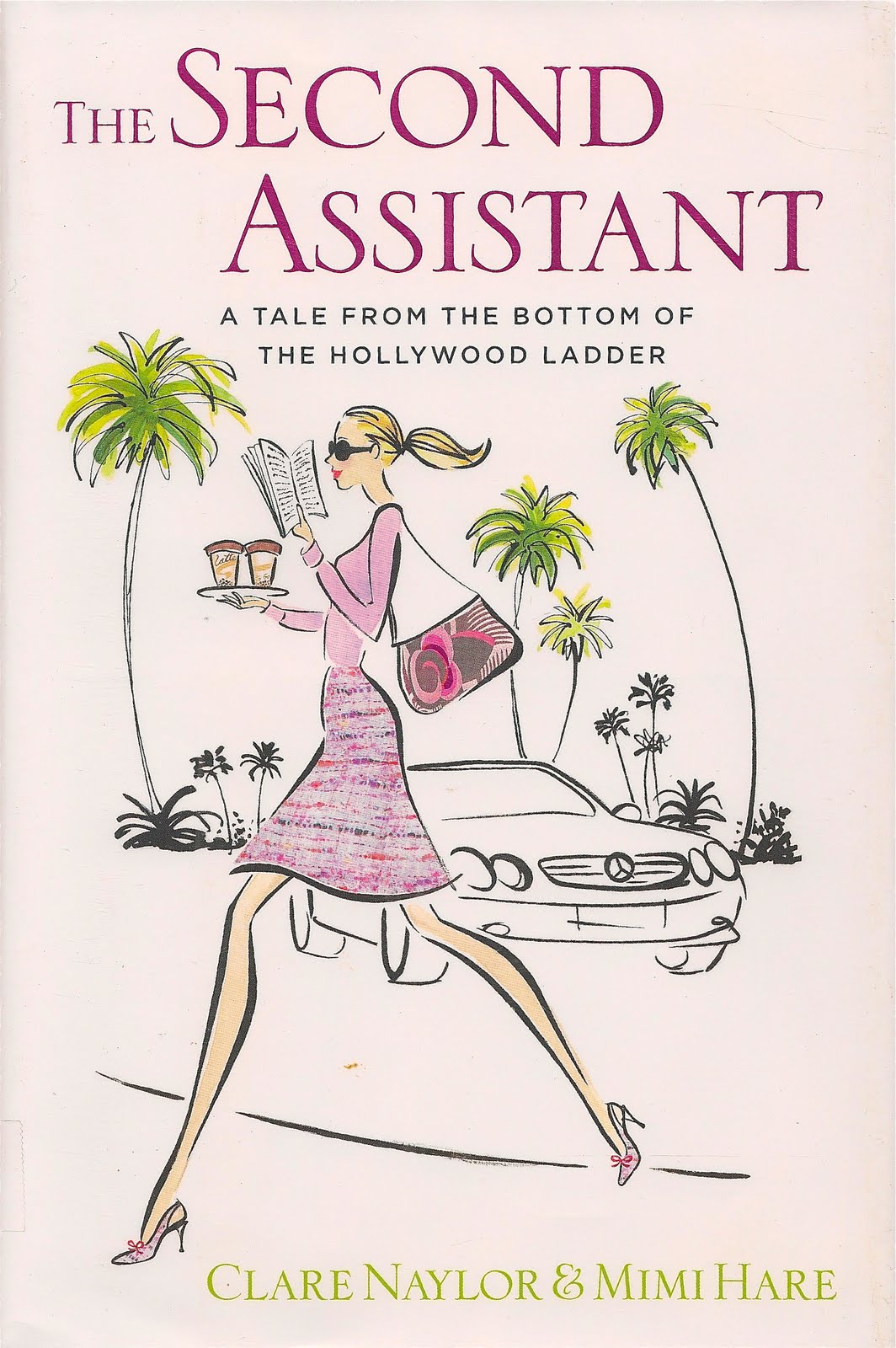
"The Second Assistant: A Tale From the Bottom of the Hollywood Ladder," by Clare Naylor and Mimi Hare


"The Second Assistant: A Tale From the Bottom of the Hollywood Ladder," by Clare Naylor and Mimi Hare, (New York: Viking; 2004), 321 pages, ISBN 0-670-03307-03.

The Second Assistant is similar to The Devil Wears Prada: a bright young woman gets a glamorous and desirable job with a difficult boss and, after a year of employment with various ups and downs, emerges as a talented young worker in her industry. The industry (if you could call it that) is the movie making business known universally by its city-host's moniker as Hollywood. As you would expect in a story about the movie business, our bright, young and enthusiastic protagonist works for a drug-addicted movie producer of considerable ability. Our protagonist also has some ability, but first has to learn about the movie business in between getting the coffee and generally embarrassing herself both at work and in her private life. She eventually demonstrates her ability and initiative and brings a new client to her company, manages to keep her job during vicious office politics and the company's near implosion to keep the new client from deserting the company.

This is a work of fiction deeply rooted in the Hollywood work experiences of the two authors. It could be called "faction'" but that would be disingenuous to the authors' abilities to portray the movie business as full of drug addicted, narcissistic, philandering nutcases who somehow seem to find time between trips to the therapist, restaurant, drug dealer and each other's bed to actually do some movie making.

If a career in movie making interests you (as either a producer or agent - in the people or non technical side of the business), then you may benefit from this "thinly veiled" story to see just what it is that you are getting into.  The Second Assistant is not great literature: its self important and self indulgent, yet provokes curiosity in the reader in the same way that a car wreck piques the interest of a driver: we slow down, take a bit of a look and eventually move along to attend to our other things. Nonetheless it is a light and breezy book that is adequately entertaining - its perfect for a long trip on either bus, ferry or train.

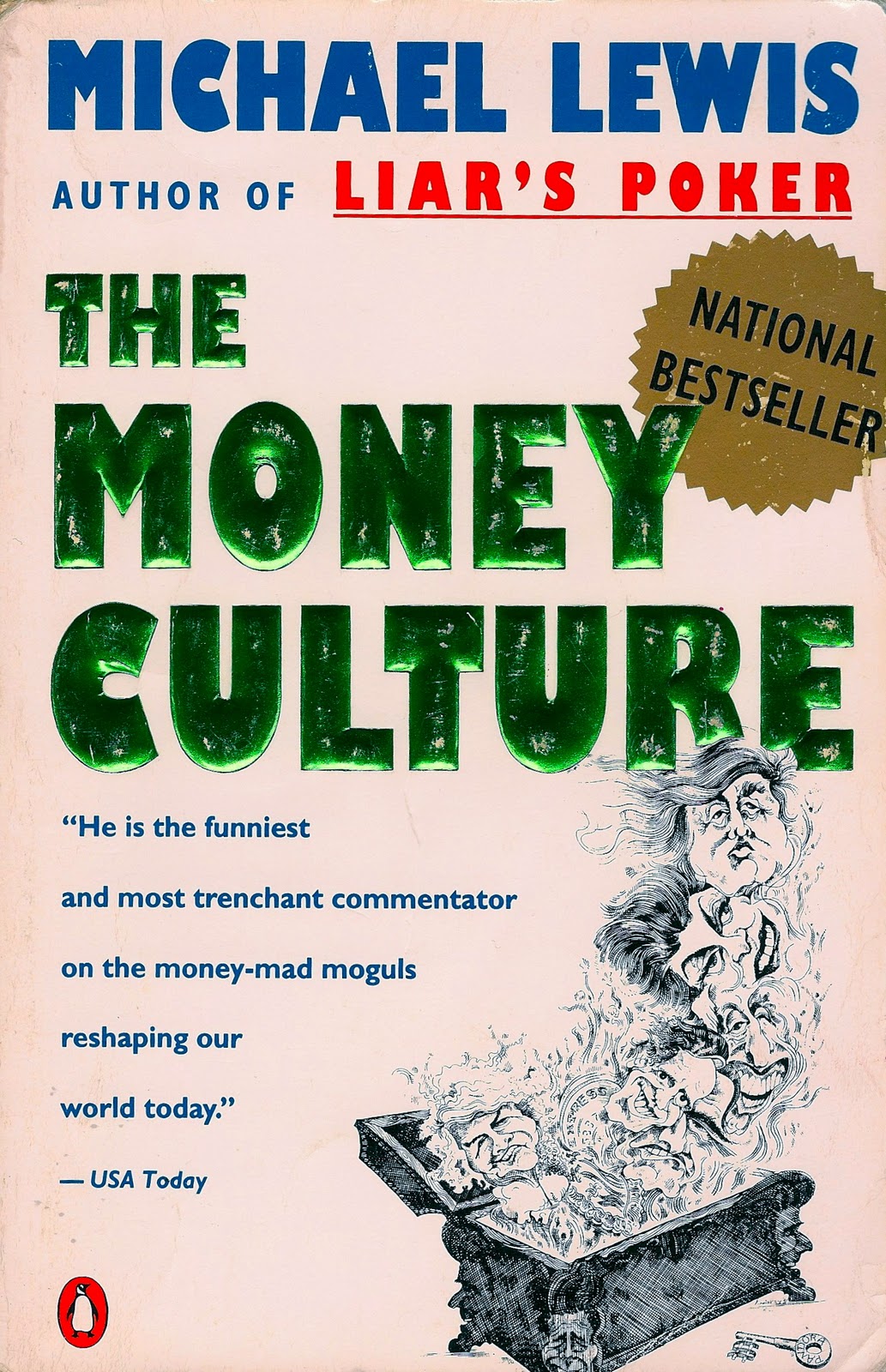
“The Money Culture,” by Michael Lewis


The Money Culture,” by Michael Lewis, (New York: Penguin Books; 1991), 282 pages.

The Money Culture is a compilation of essays and stories written in the later 1980s and early 1990s for various publications, such as Manhattan Inc., New Republic, The New York Times, The Wall Street JournalEurope, and The Washington Post. The book was published in 1991, and appears to attempt to capitalize on Lewis's success with his very successful first book Liar's Poker, a tell all account of his brief career as a Wall Street bond salesman. 

The Money Culture is arranged into three parts. The first part, "New World," examines the new world of modern finance from a variety perspectives, namely, a critique of the absurdity of mass marketing the American Express card as a symbol of exclusivity, to a series of commentaries on the then largest ever leveraged buy-out (the purchase of RJR Nabisco by leveraged buy out firm Kohlberg Kravis Roberts). Lewis gives a glimpse into the democratization of retail investing through his participation in an expensive cruise to the Amazon where customers will be given investment tips and ideas from a host of a television program about investing. We learn how the major new beneficiaries of the new money culture funded by debt are investment bankers educated at the "best school" (meaning Harvard, Wharton, Stanford etc). We also get a glimpse into the future when Lewis states that the late 1980's corporate expansions and corporate takeovers were predominantly funded by debt fund sourced from outside America. So great was the growth in debt that Lewis quoted a Princeton economics professor who made a strong case that the leveraging of corporate America would end in tears. That professor was quoted as stating that the last time we had debt in this range was in the 1920's. The professor is Benjamin Bernanke, the same man that is presently the Chairman of the New York Federal Reserve.

The second part, "Old World," contains essays on the spread of the new model of American-style, debt-fueled business activity to the old world of the United Kingdom and Europe. These stories demonstrate the manifestation of the new, brash, avarice in places where a go-getter graduate from Oxford or Cambridge with fire in the belly and a bit of hard work and a bit of leverage make a fortune as an investment banker, just like his Harvard and Stanford contemporaries.

Part three, "Other World," is a selection of essays about Japan's influence on global finance, how its savings underwrite the West's debt binge, and how it all could come undone in the West if there is another massive Tokyo earthquake and global savings are repatriated to Japan.

The Money Culture is one of two books that mark the beginning of Lewis's career as a writer. The 2010 book The Big Short is his examination of the collapse of the credit bubble. Lewis saw both the end of the credit bubble, and the beginning, so these two books complement each other quite nicely. Although its been over 20 years since these essays were written, The Money Culture marks a useful historical resource on how things were when the credit boom started, how outrageous the behavior and actions were at the beginning and at the end, and how by comparison after two decades these events in comparison ht deals seem so small, and the numbers miniscule and activities somewhat quaint. We are now used to financial scandal and endemic bad behavior that it flows over us like water off a duck's back. We are the poorer for it. The Money Culture is also a timely reminder to us as a mile marker on the road to the insolvency of the West and the financial armageddon potentially facing the United States: The Money Culture shows us that things weren't as bad as they are now, and with a bit of clear thinking and foresight, all (or a lot of) the present problems facing the world could have been avoided or ameliorated.

The Money Culture has passed the test of time. it is well written and covers topics relevant today. Some of the people featured are known to us today, and others are now forgotten, captured here at their moment of their greatest impact when their impact was at its peak. This also serves as a kind of colorful financial history of the mid to late 1980s, a passing parade of colorful characters the like of which we will not see again, not right away, but for perhaps fifteen to twenty years or do.

“The Good Girl’s Guide To Getting Lost: A Memoir of Three Continents, Two Friends, and One Unexpected Adventure,” by Rachel Friedman


“The Good Girl’s Guide To Getting Lost: A Memoir of Three Continents, Two Friends, and One Unexpected Adventure,” by Rachel Friedman (New York: Bantam Books; 2011), 287 pages.

The Good Girl’s Guide to Getting Lost is part travel memoir and part autobiography about the effect of international travel on a young, college-aged American woman from rural New York.

The story centers on three trips: the first to Ireland; the second to Australia; and third, a trip to South America. In Ireland, Friedman is an innocent abroad; she lacks confidence and the worldly experience of the perpetual backpackers with whom she associates. The experiences, customs, and attitudes of the acquaintances she makes in Ireland are all very new to the bookish, conscientious and timid Friedman. Integral to her budding maturity and confidence is her friendship with a gregarious and care-free Australian girl (Carly), an experience and confident perpetual traveler who takes Friedman under her wing. Carly convinces Friedman to visit Australia and once Friedman is newly arrived in Sydney, convinces her to stay with her family and use their house as a base for her travels during the duration of her stay. While in Australia, Friedman travels to various outback attractions on her own, and in a further example of her growing confidence, tours the east coast of Australia, breaking her journey every so often at places that strike her fancy. Once she returns to Sydney, and after a few other explorations through the south-east of Australia, she agrees to Carly’s suggestion to continue their travels together and to meet in South America. Friedman initially travels alone in South America, and alone and with Carly, meets new people from all over the world. She listens to the stories of their lives and their reasons for travelling, and, bit by bit, day by day, realizes that she too doesn’t want to stop travelling and that she has the confidence and ability to do it herself with or without her Australian friend.

This book is somewhat unusual because it is both a travel book and a memoir/story of personal growth. At the outset, Friedman is unsure of herself and hopelessly naïve in the ways of the world compared to the people she meets during her travels. By the end of the book, Friedman is more mature and experienced, and has the confidence to believe in her abilities. Her experience of other people’s motivations for travelling leads her to question her own life so far. She becomes close to Carly’s mother, an experienced traveler in her own right, whose life story has a lasting impact on Friedman. At the end of the book, we see how these people encountered through her travels have touched Friedman, who now has more confidence and courage to face life’s uncertainties, and the relentless parental and peer pressure for conformity. Friedman also reflects on the places she visits, the customs and practices of the local peoples, and the travelers she meets. She is critical and amusing without resorting to prejudice or knee-jerk reactions. Her powers of observations are acute, and her observations first rate and amusingly written with an eye for fairness and rationality peppered with the occasional criticism written in a wry and gentle manner. This ability adds spice to an enjoyable and thought-provoking book that should be considered for readers interested in travel experiences in Ireland, Australia, and South America, as wells as testaments to the belief that travel is just as much about the (physical and internal) journey as being about the destination.

"Automatic Millionaire," by David Bach


Automatic Millionaire: A Powerful One-Step Plan to Live and Finish Rich,” by David Bach, (New York: Broadway Books; 2004), 237 pages.

"Automatic Millionaire" has a simple message: anyone can follow a few simple steps and retire as a millionaire. The first tip is to live within your means, which can be restated as don’t spend more than you earn. This becomes easier than you think if you omit wasteful spending habits, such as the daily latte/cigarettes/purchased lunch. Bach shows how eliminating these types of spending, when continued throughout an entire working life can, with compounding and prudent investing of the savings, grow to over $1 million over a lifetime. The final amount accumulated will be large the more you save and the earlier you start saving.

Bach’s second tip is to save for retirement automatically in pre-tax dollars every time you get paid. Saving in pre-tax dollars (using one of the tax deferred saving plans such as 401K, 457 etc) can quickly multiply your savings when investing pre-tax dollars, particularly when you have an employer that matches your contribution. Bach emphasizes that pre-tax automatic saving is the key. By investing pre-tax money the amount you invest and accumulate over your working life is greater than if invested from taxed money.

Bach’s third tip is to have a rainy day fund or emergency fund. Sometimes life brings large unexpected events, such as unemployment or large medical expenses. Bach states that the best way to manage such events is to have an emergency fund or cash reserve equivalent to at least 3 to 6 months of expenses. To his credit, Bach also provides readers with tips for finding secure places in which to keep an emergency fund, such as at-call high interest bank accounts, high interest deposits, and certain U.S. Treasury instruments.

The forth tip Bach gives is for readers to make their monthly mortgage payment obligation in two two-weekly payments. By paying the same monthly total in two installments two weeks apart, a homeowner can pay off their home a lot earlier (by almost 7 to 10 years) and reduce the total amount of interest paid to their bank over the life of the (now reduced term) loan. This simple task enables a homeowner to retire their debt much earlier, lower their total interest payments, and enable the homeowner to invest the money previously allocated to repaying the mortgage.

Bach’s fifth tip is to tithe or donate money to charitable or religious causes. Not only does the donation benefit the receiving organization, but it also is, in many instances, tax deductible.

Bach’s book is targeted to people interested in improving their financial position. His advice is sensible, and the implementation strategy (establishing once-off automatic savings, investment and mortgage repayment plans) easy to implement. The book is a good introduction for people interested in securing their financial security. Bach nicely shows how his strategy works for all income levels. He gives a real-life example of how using this strategy, a couple earning $40,000 per year, owns two paid off houses, and has investments approaching $1 million. To some readers, Bach’s message maybe familiar, or may have been made by other writers or personal finance advisers. This is probably good news as it endorses the strategy. It is a powerful message told in an accessible and non-technical style. It is a fine guide to convince and help regular workers on any income to live within their means, and to set up automatic plans that will ensure that anyone can become a millionaire at retirement.

"One For The Road: Hitchhiking Through The Australian Outback," by Tony Horwitz


"One For The Road: Hitchhiking Through The Australian Outback," by Tony Horwitz, (New York: Random House, First Vintage Departures Edition, 1988), 222 pages.

Travelling through outback Australia by car is no easy feat, but Tony Horwitz has gone one further in hitchhiking through it, alone. One For the Road is the story of Horwitz’s mid-1980's hitchhiking journey that started from Sydney and went anti-clockwise through the outback parts of the states of New South Wales and Queensland until he reached the Three Ways in the Northern Territory. Horwitz then changed direction and travelled south through Central Australia until he reached the southern coast, where he changed directions again travelling clockwise, first west, then north and later east until he reached Darwin. Hitchhiking anywhere isn't easy. Divers are reluctant of offer rides. The conditions in outback Australia make hitchhiking difficult. There is the oppressive heat, the flies, the long distances between tiny towns, the rough and unsealed roads, and perhaps alarmingly, the alcohol-fueled drivers (who regularly drink beer while driving) that take a life in their hands when they offer a ride to the hitchhiker. Horwitz endures these difficulties, survives the harsh conditions, and runs out of ways to describe the monotonous and featureless landscapes to tell us of his experiences of living on the road. The generous souls that offer him a ride are a varied lot. They include a family from Tasmania (where the mine closed) looking for work in the Western Australian mines, an angry and aggressive youth going for a drive for something to do, truck drivers who regret not being able to see their families and are strangers in their own home, a retired naval officer who hit the road when the in-laws were about to visit who still has the sailor's habit of keeping a detailed log book, a young physician out for a drive in the countryside, and a car load of young aboriginal men that drive a car that barely runs. Horwitz also visits places with strange names that the tourist rarely see, goes to small "one pub" towns where drivers only stop to re-fuel and eat before embarking on the next leg of their journey into the "ghastly blank." He also ventures into larger towns and cities like the mining town of Mount Isa, Alice Springs, Perth, exotic Broome, and his ultimate destination of Darwin. He also chronicles his unusual adventures, such as when he was lucky to avoid meeting his maker in a car accident while driving from Ayers Rock / Uluru to Alice Springs. Or there's the account of his day on a crayfish trawler off Geraldton where he spends most of the day seasick, much to the delight of the rest of the crew, and his hitching a ride with a wheat train where he spent time up front in the engine driver's cab. Much of the book has an absence of any awareness of time or deadlines, but at the end of his journey, they become a major pre-occupation because he has to be in Darwin on a certain day at a certain time to catch a place. Time is against him in the end, and he has to use his wits to avoid being beaten by it.

The great strength of this book is that it captures a part of Australia that few people, let alone the majority of coast-hugging Australians, have ever experienced. Horowitz also sees it with ordinary people. He shares with us the joys and travails of the hitchhiker who doesn't know what his next driver will be like, friendly, surly, vibrant conversationalist or it opposite. He shares with us the experience of his front-seat confessional, his driver's thoughts, aspirations, fears and regrets, all while driving through the vast landscapes slip past. It is these features that make One For The Road more than just a travel book; its an inner journey of discovery for the author, and for him, the end of his time hitchhiking. His brush with mortality keeps replaying in the videotape of his mind, reminding him of how lucky he was that the car rolled one way, and not the other. A conversation with one female driver makes him long to be at home his wife in the safety of the suburbs in Sydney. His celebration of Passover in Broome is truly moving, and perhaps the best chapter of the book: it is a reminder of how our past and the religion that we may (or in the author's case may no longer) practice is part of our identity. It is something that makes us what we are, for a brief moment or evening, unites us in a common bond with complete strangers when a long way from home and scattered throughout the world far from our loved ones.

One For The Road is an outsider's view of Australia, a view that is accurate without being condescending, sentimental or evangelical. Perhaps this is because the author is a journalist, someone who sets it all out for us to see with our own eyes with brutal honesty, compassion and affection. He shows here the skills of a fine writer, someone who unsurprisingly went on to write other fine works of non-fiction. For these reasons, it should appeal to a wide audience of lovers of good writing and interesting stories, lovers of travel stories, and readers interested in the "real Australia" that isn't seen in the travel brochures.

“Teacher Man,” by Frank McCourt


Teacher Man,” by Frank McCourt, (New York: Scribner; 2005), 258 pages.
  
In Frank McCourt’s third book, “Teacher Man,” he again writes about his favorite subject, himself; however, in this book McCourt expands upon his earlier recollections of his vocation as a teacher in the New York City public school system. This subject was covered quite nicely in the second volume of his autobiography “’Tis,” where he wrote of his experiences as a teacher as part of the journey of his life from an impoverished immigrant to an accomplished and revered high school teacher. His time as a teacher was an important component of the story of his life in that book. “Teacher Man” is different in that it puts Frank McCourt, the respected teacher, as the subject of the book, and relegates other aspects of his life into the background.

Teacher Man,” while predominantly autobiographical, is also a commentary on the teaching profession in the public school system. McCourt notes that success is determined by the speed at which teachers abandon the classroom and seek shelter in the administrative bureaucracy. Successful teaching is admired for its own sake, but it is not rewarded like successful teacher administration. McCourt also demonstrates what teachers like him had to do to “break through” with dis-interested students. As the teacher of very ordinary students, he sometimes had to be innovative and use methods that some might think of as radical or inappropriate. For example, to get the attention of the vocational school English class, he drew upon their extensive experience of forging parental excuse notes to teach a class on writing excuse notes. With a fully attentive and engaged class, he challenged them to write an excuse note from Adam of God. Success in the classroom was not always mirrored in McCourt’s private life. He failed to fulfill his own (or his wife’s) ambitions of becoming successful: he did not become a teaching administrator, and spent two years in Ireland studying for a Ph. D without success.

This book succeeds on many levels. It is a fine memoir of the career of a teacher. It is also a critique and commentary on the successes and failures of the American public school system. It also gives us an insight into how good teachers can make a difference in the lives of students, and occasionally fail to “get through” to certain troubled students. It also goes over  McCourt’s well trodden ground of the difficulties faced by new immigrants in escaping their impoverished childhoods. For all these reasons, this is a highly commendable book. Despite such accolades, it is not without flaws. At times McCourt lapses into the habit of giving us too much detail of certain aspects of his personal life. His disclosures may offend some readers or be considered in poor taste, particular those that detail his infidelities. Nonetheless, it is honest; perhaps to a fault, but it is a very rewarding read. And now that this revered literature teacher has passed away, we can be thankful for what he has written, while speculating on what he may have written had he not passed away. One can’t help but think that there may have been another book or two in Frank McCourt on a subject other than his autobiography. Unfortunately that was not to be, and we are all the poorer for it. 

"Buying In," by Robert Walker


"Buying In: The Secret Dialogue Between What We Buy and Who We Are," by Robert Walker (New York: Random House; 2008), 291 pages.

Buying In is a refutation of the professional marketers' arguments that "brands are dead" and that "advertising no longer works." Author Rob Walker argues that people are embracing brands more than ever, that brands are fracturing, and people are able to access these brands through combinations of technology, viral marketing, and the use of key people or word-of-mouth agents and promoters marketing products on behalf of corporations, acquaintances, and friends. Marketing is now entwined with cultural and social connections. Walker also explores a practice he calls murketing (a combination of murky and marketing) and how people buy products not just for their use, utility or function, but also as expressions of their identity. It’s as though you are what you buy.

Buying In appears to be like Malcolm Gladwell's books (the covers seem to be somewhat similar), but it has none of Gladwell's diverse subject matter or arguments on a range of subjects. Buying In is about marketing and how innovative marketing programs have been successful in a technological age. The narrow focus of this book is its greatest strength, and makes this book mostly of interest to marketers and merchandisers. Non-marketers, like me, might find this book repetitive and a long-winded explanation for what should be a simple story. It may also be of little value to the novice reader of marketing books, unless it is a steeply discounted remainder copy at a discount store.