"What Should I Do With My Life,” by Po Bronson


Po Bronson, "What Should I Do With My Life,” (New York: Ballantine Books; 2003), 434 pages.

In What Should I Do With My Life, Po Bronson tells the stories of people who tried to find the answer to that question. Bronson surveyed and interviewed many people that were looking to change the direction of their life, to do something more meaningful, to do the thing they were put on this earth to do. This book contains the stories of how they worked out the answer to that question. Bronson interviewed many people, and included in this book the stories of a selection of the people he interviewed.

This book’s strength is it’s sympathetic but arms-length portrayal of people working out what to do with their life. Each story is unique. Each story portrays people from a variety of backgrounds and countries, and shows how they discovered the answer to the question of what to do with their life. Some people found the answer in front of them, some travelled, some made bold changes, some make small changes, and others had to try many different jobs and professions to find the answer. The stories in this book show that there is no one answer to this question. People looking to work out what to do with their life may find an answer, but that answer is likely to come to them in one a variety of possible ways.

Readers looking for guidance should note that the author does not give specific advice to the reader. He doesn’t provide a quick self help formula or a list of things to do. Bronson teaches or guides by example. His book’s message is that if you are looking for the answer to the question “What Should I Do With My Life,” you may benefit from this collection of stories of people that asked the same question and struggled to find an answer. You too can learn from these people and work out the answer for you, but only you can answer this question.

This book will appeal to readers looking for their life’s purpose, calling, or vocation. It doesn’t provide specific answers, but it will provoke questions. Ultimately this book teaches the reader that there may not be quick fixes, that you may stumble and search to find the answer, and that you may benefit from the example of others that have also asked this question. This selection of stories benefits readers asking the same question. If you are wondering what to do with your life, this may be the book for you.

Not Taco Bell Material by Adam Carolla


Adam Carolla, Not Taco Bell Material, (New York: Crown Publishing; 2012), 330 pages.


This autobiography tells the story of Carolla's rise from neglected child of welfare-dependant parents living in a crummy house with a dirt lawn in North Hollywood to his current status as a millionaire businessman. Carolla discusses his upbringing by framing them around the various houses and apartments he lived in, and what he got up to while living in them. He details a series of depressing residences, and the major memories of his upbringings linked to those places. With comic flare, profanity, and at times vulgarity, we see how Carolla stumbled through school ill-equipped for life. Upon graduating from high school he was barely able to read. With few options and no  guidance or  encouragement from his parents, he took up a series of menial jobs such as carpet cleaning, digging ditches, carpentry and being a boxing instructor. Always possessed with the gift of the gab, Carolla eventually worked out that he could either continue to work with his hands, or develop his ability to be funny. After much failure, persistence, and by making his own luck, Carolla broke into radio (initially for no pay) and later became a paid host of a nationally syndicated radio show. Carolla subsequently moved into developing and staring in a number of television shows, stand-up comedy, acting, movie production, as well as developing a podcasting network. From humble beginnings, Carolla has become a very successful businessman.

This book is a very funny telling of Carolla’s life. He can be crude, vulgar, funny, but most of all honest. No one in his life is spared, including his family and close friends. It is a very funny book but at the same time quite serious. He is critical of a school system that could let him graduate fro high school barely able to read. He is critical of television, movie and radio executives that have few creative skills, but world class expertise in ruining projects. It’s also a damning indictment of his parent’s hands-off parenting. Despite this, it’s inspirational because Carolla shows that despite his lousy childhood and his absent parents, that it was possible to develop and use his talents to make a success of his life. This is the real point of this book: in spite of your background, with hard work, a lot of failure, and setback, hard work and dedication and grit can bring you success.

The Devil's Guide to Hollywood by Joe Eszterhas


Joe Eszterhas, The Devil's Guide to Hollywood: The Screenwriter as God,  (New York: St. Martin's Griffin; 2006) 379 pages.

This unusual book by a successful screenwriter is part biography, part insider's guide for new players, part anecdote collection, and part critique. Eszterhas knows the movie business, and this book is his take on what Hollywood (as in the movie making business)  really like. He delivers detailed lessons on writing the script, selling the script, filming, and working with the producer, director, the studio, actors and critics. The book contains the wisdom and wit of others, and also also the sharp criticisms of Eszterhas's competitors such an William Goldman and Robert McKee. The lessons on these themes are not just his own, but also statements from many others in the business. Most of the books comprises quotes from others in the business, delivered in an entertaining and truthful way that is immensely entertaining.

This is a book for people interested in learning what the movie business is really like. If you read it, you will see that its a sewer full of all sorts of vices that at times can produce great art, and at other times, complete dross. Even Eszterhas is repelled by Hollywood, choosing to rear his children far away, in a very different part of the United States. The book's great strength is its honesty, comprehensiveness, and compilation of a wide variety of voices that have worked in Hollywood, both now and in years past. Esterhas uses and quotes profanity, and discusses subjects of an "adult nature," so reader discretion is advised.

"The Drop," by Michael Connelly


Michael Connelly, The Drop, (New York: Hachette Book Group; 2011), 483 pages.


The Drop is another book in the Harry Bosch series written by Michael Connelly. Bosch is an uncompromising Los Angeles Police Department detective of retirement age, who stays on the job because he must;. Solving murders is what he does, and he does it well. Bosch is a character with a single-minded pursuit of justice on behalf of the murder victim. He is determined and single-minded in pursuit of the murderer, often to the detriment of his family relationships, his work partner and his boss. His motto is everyone matters, or no-one matters.

Bosch is in familiar surroundings in The Drop, namely, the open unsolved or cold case unit, although with a twist. On the same day, Bosch is assigned two new cases, one open-unsolved, and another a new case. In the new case, Bosch and his work partner were chosen by the Commissioner for the new case, the murder of the son on an old Bosch nemesis now in politics. The plot involves Bosch and his partner working the case while negotiating the rocks and shoals of Los Angeles Police Department   and Los Angeles City Council politics. Bosch's second case is a cold case that became active due to a positive finding from a DNA test. A problem is revealed with the DNA test when it is positively matched to a person aged 8 years at the time of the murder. Bosch's relentless pursuit of the killer in light of this unusual DNA evidence reveals a startling and gruesome killer that had been operating in Los Angeles for more than 20 years.

Connelly displays all his writing talent in The Drop. He has a gift for the seemingly accurate and realistic portrayal of police procedure. He combines his eye for detail, knowledge of police procedure and gift for storytelling to write a fine book. This combination gives us an entertaining and fast-moving story consistent with Connelly's previous work of police mystery writing.

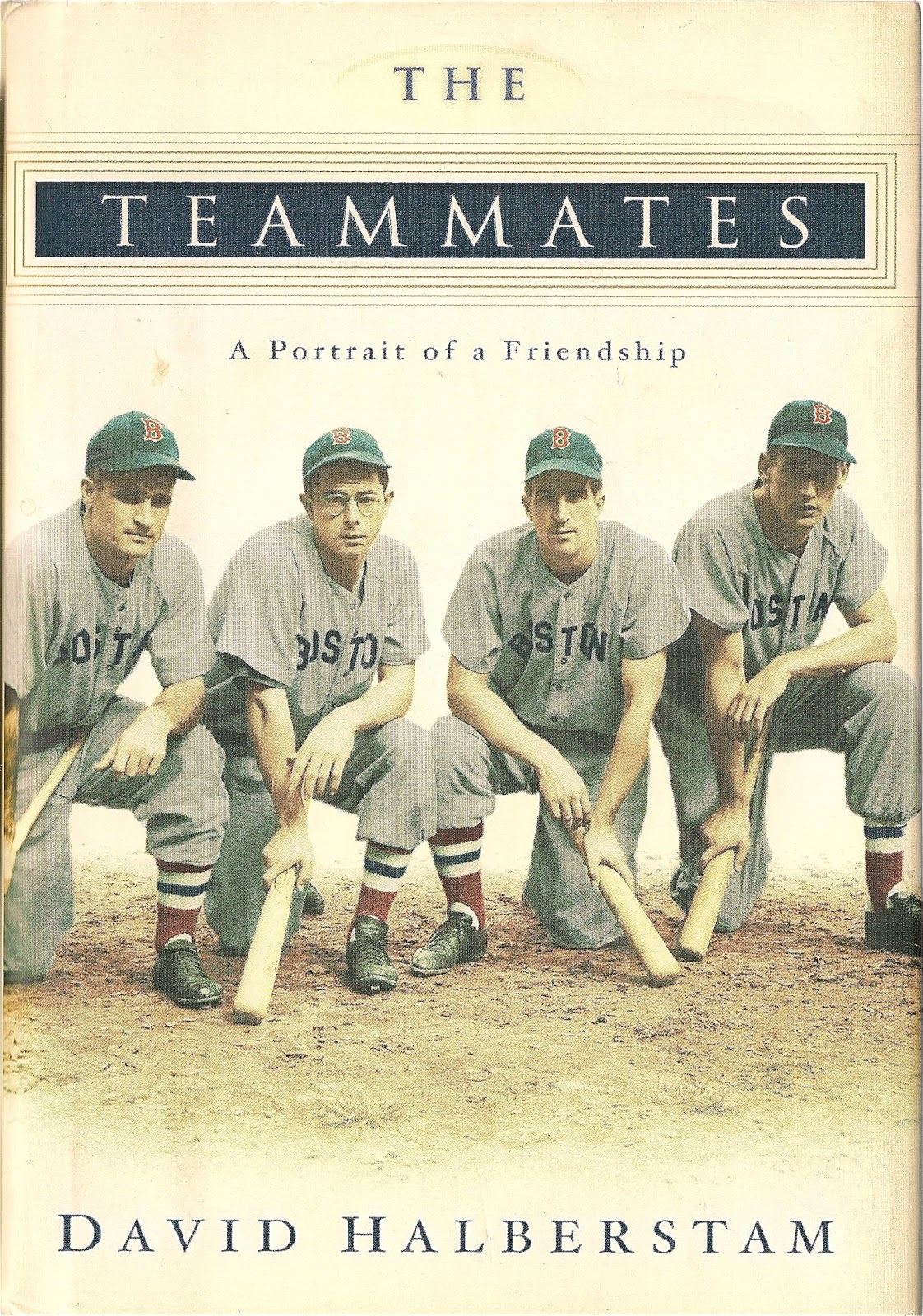
"The Teammates," by David Halberstam


David Halberstam, "The Teammates," (New York: Hyperion; 2002), 217 pages.

This small book is about the enduring friendships between four former professional baseball players (Ted Williams, John Pesky, Dominic DiMaggio and Bobby Doerr). The author provides an oversight of how each started his professional baseball career, how they were recruited to play in Boston, their lives after they finished playing baseball, and the ways in which the friendships continued for the remainder of their lives.

The book benefits a great deal from the author’s love of baseball. He is very knowledgeable of the game, and knows a great deal about these four players from having written a previous book about their famous team the Boston Red Socks. Hence, the obvious appeal of this book to baseball fans. Readers should note that The Teammates is more than just a book about baseball; it’s also a book about friendships and how they endure throughout the years. The author shows us what friends do for each other throughout the years, and what they do for each other in their twilight, more vulnerable years. We also get a glimpse of the lives of professional sportsmen, and how each of the four men made different choices that had significant impacts of the rest of their lives. This dual aspect of the book makes it enjoyable for the baseball fan and the non-fan, or anyone interested in how four men could remain friends for about seventy years.

Adventure Capitalist: The Ultimate Investor's Road Trip, by Jim Rogers


Jim Rogers, "Adventure Capitalist: The Ultimate Investor's Road Trip," (Random House: New York; 2003), 357 pages.


Jim Rogers, former hedge fund manager, likes to travel. His first book, Investment Biker, recalled his around-the-world trip by motorbike. This book, Adventure Capitalist, is a sequel. It’s an account of his travel around the world by car, a trip that took 3 years. He and his wife made a trip in a customized four wheel drive Mercedes sports car. The journey started in Iceland and continued through the U.K., Southern Europe, Central Asia to China, Japan, Russia, Scandinavia, the east and west coast of Africa, Australia, New Zealand, South America, Central America, and through the USA to Canada and Alaska.


Like Investment Biker, this book is more than a travel book. It contains description of the author’s travels, as we would expect. More interestingly, it contains Roger's opinions on many of the countries he visited, such as whether it was blighted by corruption or poor governance. He is particularly expansive on various countries' financial condition, whether the country’s currency was being debased, and if conditions were optimal for improving the lives of that country’s citizens. As much as he comments on the counties he visits, Rogers also devotes considerable space to reflect on life in the United States and its place in the world. Rogers is an optimistic libertarian, and his travels force him to reflect on US policies, such as foreign policy, foreign aid, various international institutions (such at the World Bank and the International Monetary Fund), and domestic economic policies. These reflections are frequently critical, but are neither theoretical nor polemical, but based on his understanding of the world and various nations gained from his unique perspective as an extensive global traveler.

Roger's investment philosophy is unorthodox, as is his commentary on socio-political situations. His views are rooted in his on the ground observations gained by going into the field where there are few, if any, 5 star hotels. His experience at school, college and business taught him that experts were usually wrong, hence his bias towards learning for himself through his own experiences. His travels are characterized by the slaughter of sacred cows (meaning conventional views), the puncturing of various balloons and the laying to rest the ore-conceptions of the world held by certain "authorities," many of whom have never left home (p.4).

A strength of this book is the recollection of his journeys through a large number of countries he visited; however, this also restricts the author from writing about every country in detail. Some countries are covered in great detail (China) while others are barely mentioned. This limitation sometimes comes across as the story being rushed.  At times, the great distances being covered through exotic locations barely rate a mention.

The book excels in other areas. First, it exposes a few myths about the international travel in Africa and South America, and demonstrates that with ingenuity and determination that it is possible to drive a car around the world. Second, he exposes a few myths and pre-conceived notions about African countries and their government’s economic policies, the causes of poverty and misery, and the causes of prosperity and economic growth – here’s a hint, it not United Nations aid projects. Rogers observes in such a way and with a view to seeing conditions that will encourage profitable investing. Third, Rogers reflects on the USA. His unique perspective of travelling around the world gives him perspective to comment on conditions in the USA, and to reflect and make prediction about the USA’s future. Anyone with more than a passing interest in travel, the USA’s place in the work, and

This book is more than a travel book. It’s a reflection on life, the world, and the place of the USA in the world, and assessing foreign countries as places to invest should enjoy this book.

Rigged: The Story of an Ivy League Kid Who Changed the World of Oil, from Wall Street to Dubai, by Ben Mezrich


Ben Mezrich, "Rigged: The Story of an Ivy League  Kid Who Changed the World of Oil, from Wall Street to Dubai," (Harper Collins: New York; 2007), 294 pages.

Rigged is Mezrich's latest book about kids with Ivy League university educations that go on to make fortunes. In this relatively unexciting and unexceptional story, a Harvard University graduate goes to work for the New York Mercantile Exchange to establish the Dubai Mercantile Exchange.

The most revealing aspect of this book is its expose of the itty-gritty details on how the Dubai Mercantile Exchange was founded, as well as the broader subject of establishing a new business in the Arab world. Readers will discover the importance of working with an Arab partner familiar with the business practices in the West and the Arab world. Readers will also see how such partners can help negotiate difficulties with obtaining approval of religious leaders in circumstances where business practices have some conflict, or potential conflict, with Islamic law. Finally, we see how it is sometimes necessary to appeal to the lower instincts of established industry stalwarts in order to develop new operations.

If this book has any shortcomings, it would be Mezrich's tendency to stray into hagiography and hyperbole. He praises almost without criticism and glorifies the protagonist's success without much broad perspective. Michael Lewis fails spectacularly in writing books that discourage bright young kids from going to Wall Street to get rich. Mezrich has no such moral imperative: he writes books like Rigged that are sufficiently entertaining to encourage bright kids to go to Ivy League school so they can "change the world," which means, find new ways, or new twists on old ways, to make a fortune working on Wall Street.

A Year in the Merde by Stephen Clarke


Stephen Clarke, A Year in the Merde, (New York: Bloomsbury; 2004), 276 pages.

Stephen Clarke's book is a fictional account of an English man's year of residence in Paris. Hired by a French company to open a chain of English tea rooms, a smart-alec Englishman finds himself juggling a group of grumbling and barely competent French employees, a devious and manipulative boss, and a succession of promiscuous girlfriends (including the boss's daughter). He becomes immersed in French culture and finds it amusing and confusing. After a series of adventures that include a possible purchase of a house in the country, he eventually establishes an English tea room without the control of a treacherous boss.

The best aspect f Clarke's book is his critique of the French from an English perspective. Clarke's prose is witty, acerbic, and very funny, despite is tendency to drift off into discussions of sex. If the subject offends, be warned. Yet, the principal character in the book is a 27 year old single man, so it is to be expected that this subject should cross his mind. Clarke's critique of life in Paris are hilarious and cruel, but typically English. An interesting aspect is how the main character starts to appreciate Parisian life over the duration of his stay. Upon his return to England, he gains a fresh perspective on English life including the ways of life of the typical Englishman. Alas,he eventually admires and appreciates many aspects of Parisian life.

This book will appeal to lovers of French culture, people interested in the differences between the English and French, people interested in travel books, particularly books about Paris. The book's is also an interesting story that hows that culture shock is real, and that an outside can come to terms with difficult situations and conditions to achieve some success. On many levels, this is an enjoyable book.

"Investment Biker: Around the World with Jim Rogers," by Jim Rogers


Investment Biker: Around the World with Jim Rogers, (Hollbrook, MA: Adams Media Corporation; 1994), 402 pages.

From March 1990 through August 1992, the author and his girlfriend travelled around the world on their BMW motorcycles. Starting in New York City, they flew to Ireland and travelled through southern Europe to China and Japan, then turned around and went through northern Europe back to Ireland. They then drove the length of Africa from north to south, almost circumnavigated Australia, rode through New Zealand,  rode through the Americas from Cape Horn in the south to New York in the north east through to Anchorage, Alaska, traveling a total of 65,000 miles. The book is a record of his travels including observations of the countries he visited. Most but not all of the book is devoted to his travels. We learn of the difficulties of riding a bike around the world though conditions ranging from first class roads to bumpy dirt tracks. The book also casts a keen observer's eye at the countries through which he travels. He comments on the living conditions of every country he visits, and gets to the heart of what makes each country successful or unsuccessful. As a professional investor, Rogers also comments on the economic conditions of many countries, primarily based on his observations and interactions with the people he meets. He gets to the heart of what makes a county successful, what makes life good for its citizens, what makes currencies more valuable, and others less valuable. In light of his observations about the countries he visits, he returns to a repeating theme, namely the similarity between the direction of the U.S.A.'s economy and that of failed third-world countries around the globe.

This is a gem of a book. It is s both a record of an amazing round-the-world motorcycle trip, and a reflection on what makes a country successful. Rogers's analysis and writing is direct and honest. It is  unencumbered with flowery introspection or self-doubt. It is full of practical advice and commonsense for the traveller and to a lesser extent the international investor.  If the book has a weakness its his failure to give any detailed observations of his travels through the United States. He also writes comparatively little of his travels through Australia. This limited treatment of two large countries surprised me. I think the book is the poorer than it could have been due to so little coverage of these large countries. Nonetheless, this is a very good book that should be enjoyed by readers interested in travel, investing, and motorcycle travel journeys.

The Scarecrow by Michael Connelly


The Scarecrow, by Michael Connelly, (New York: Hachette Book Group; 2008), 562 pages.

In The Scarecrow, Michael Connelly goes back to the old well of The Poet, and takes another drink.  The characters from that book feature again in The Scarecrow in another story about the hunt for a serial killer. The principal character, Jack McEvoy is an all-but-washed up journalist at the Los Angeles Times. While reporting on a murder confession, he discovers, and believes, that a confessed killer has been framed and that the real murderer is a serial killer. Unable to convince the Los Angeles Police Department, Federal Bureau of Investigation, and his own employer of the merits of his theory, McEvoy attempts to solve the crime himself, and in the long a circuitous investigation, gets his co-worker killed but like all goes journalist heroes, gets his killer in the end.

As the cover blurb notes, this book is "high-grade entertainment," and suitable written to retain the reader's attention through surprises and twists. Connelly is an entertaining writer, and this book is of sufficient quality to live up to the author's reputation of producing crime fiction at its best. Readers of crime fiction should find this book adequately entertaining, as long as you can accommodate the fact that the entire story's premise is that a journalist is more capable of solving a string of murders than two law enforcement agencies. If readers can rationalize away that fact they should enjoy this book.

"Warren Buffett and the Art of Stock Arbitrage," by Mary Buffett and David Clark


"Warren Buffett and the Art of Stock Arbitrage," by Mary Buffett and David Clark, (New York: Scribner; 2010), 153 pages.

This book is another addition to the expanding category of books about Warren Buffett's approach to profitable investing. The unique feature of this book is that one of the authors shares the surname of the subject (because she was once married to one of his sons). This small book explains arbitrage, with occasional references to actual Buffett arbitrages. It also goes over topics of interest to the novice investor, such as what arbitrage is, types of arbitrage, how it can be used with great certainty to increase annual investment returns, how leverage (or borrowings) can greatly improve investment returns when it is used effectively (and the opposite - risk of loss or low profits in certain situations) and overviews of various real-world examples where Buffett used arbitrage to earn outsized investment returns. For example, the authors discuss the following:

·               friendly mergers
·               hostile takeovers
·               buy-backs and self-tender offers
·               corporate liquidations
·               corporate spin-offs, and 
·               stubs.

This is not a book for experts; on the contrary it is an introductory book on the subject of arbitrage. Experts should by-pass this book for I doubt they will benefit from the contents. It is mostly a book for novices on how arbitrage situations can be very profitable if executed properly. The spice or spin is added by the references to Warren Buffett through frequent reference to his success as an arbitrager, and example of situations were he profitably engaged in arbitrage. The message of the book is that the reader can profit, just like Warren Buffett, if you follow the guidelines provided in this book.